Teacher Salary in Private School India 2026: Primary, TGT, PGT & College Level Complete Guide
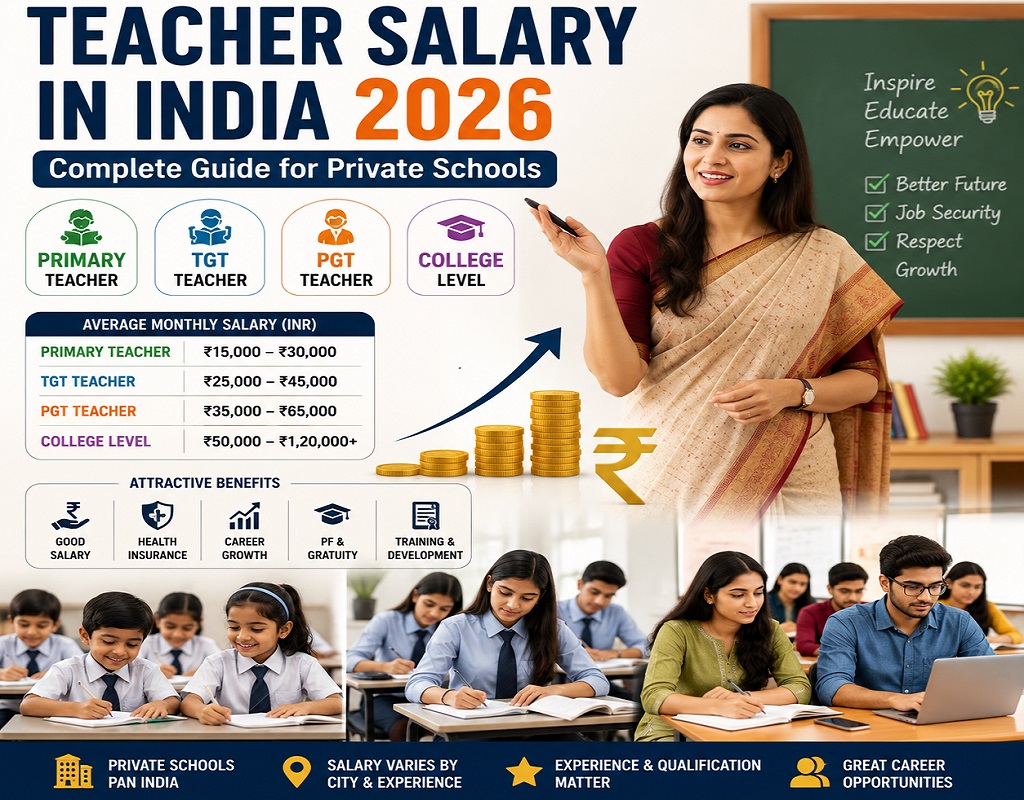
Thinking about a teaching career in a private school? Smart move — but before you walk into that interview, you deserve to know exactly what you are signing up for financially. The honest truth is that private school teacher salary in India can vary wildly. A primary teacher in a small-town private school and a PGT science teacher in a reputed CBSE school in Delhi can both be called “private school teachers” — yet their salaries might differ by three to four times.
This guide breaks down teacher salary in private schools across India by level (primary, secondary, and college), experience, subject, and city. Whether you are a fresh B.Ed graduate or an experienced professional evaluating a school switch, this article gives you the real numbers to negotiate smarter.
📌 Quick Answer: Private school teacher salary in India ranges from ₹15,000 to ₹1,00,000 per month, depending on the level taught, school tier, location, and experience.
Private vs Government Teacher Salary: The Real Difference
Before diving into the numbers, let us address the most common question people ask: Is private school teaching worth it compared to a government job?
The short answer is — it depends heavily on which private school you are joining. Government teachers benefit from structured pay scales under the 7th Pay Commission, plus DA, HRA, and job security. Private school teachers, on the other hand, are not governed by any Pay Commission. Their salary is entirely at the discretion of school management.
| Criteria | Government Teacher | Private School Teacher |
| Starting Salary | ₹42,600/month | ₹15,000–22,000/month |
| Dearness Allowance (DA) | 53% of basic (Jan 2026) | Rarely offered |
| House Rent Allowance | 9%–27% of basic | Few schools offer |
| Job Security | High (permanent posts) | Low to moderate |
| Pay Commission Coverage | Yes (7th & 8th CPC) | Not applicable |
| Growth & Promotions | Structured (MACP scheme) | Depends on school policy |
Top-tier private schools in metros, however, do close this gap significantly — and in some cases offer better take-home salaries than government schools, especially at the secondary and college levels.
Primary Teacher Salary in Private Schools (Classes 1–5 | PRT)
Primary teachers, also known as PRTs (Primary Trained Teachers), handle children in Classes 1 to 5. This is the entry-level teaching role in most private schools.
Qualification & Eligibility
- Minimum: D.El.Ed (Diploma in Elementary Education) or B.El.Ed
- Ed is increasingly preferred even at the primary level
- CTET (Central Teacher Eligibility Test) or State TET is required for most recognized private schools
Salary Range for Primary Teachers
According to PayScale 2026 data, the average annual salary for a primary school teacher in India is ₹2,58,055 — which works out to roughly ₹21,500 per month. However, entry-level teachers often start lower.
| Experience Level | Monthly Salary Range | Annual CTC (Approx.) |
| Entry Level (0–2 years) | ₹15,000 – ₹20,000 | ₹1.8 – 2.4 LPA |
| Mid-Career (3–6 years) | ₹22,000 – ₹32,000 | ₹2.6 – 3.8 LPA |
| Senior Level (7+ years) | ₹33,000 – ₹50,000 | ₹4 – 6 LPA |
City-wise Primary Teacher Salary
| City | Entry-Level/Month | Experienced/Month |
| Delhi / NCR | ₹18,000–22,000 | ₹35,000–48,000 |
| Mumbai | ₹17,000–21,000 | ₹32,000–45,000 |
| Bangalore | ₹16,000–20,000 | ₹30,000–42,000 |
| Ahmedabad | ₹14,000–18,000 | ₹25,000–35,000 |
| Lucknow | ₹13,000–17,000 | ₹22,000–30,000 |
| Tier-3 / Small Towns | ₹10,000–14,000 | ₹15,000–22,000 |
Career Growth for Primary Teachers
Primary teaching is not a dead-end career if you plan it well. Most experienced primary teachers move into roles like Academic Coordinator, Head of Department, or even Vice Principal over time. Each step up brings a significant salary bump — often 30% to 50% more than a classroom teacher.
Secondary Teacher Salary in Private Schools (TGT & PGT | Classes 6–12)
Secondary school teaching is where salary jumps start to get interesting. This tier splits into two important categories: TGT and PGT.
TGT vs PGT: What Is the Difference?
| Criteria | TGT (Trained Graduate Teacher) | PGT (Post Graduate Teacher) |
| Classes Handled | 6 to 10 | 11 and 12 |
| Minimum Qualification | Graduation + B.Ed | Post-Graduation + B.Ed |
| Starting Salary (Private) | ₹18,000–22,000/month | ₹25,000–30,000/month |
| Experienced Salary | ₹35,000–45,000/month | ₹45,000–60,000/month+ |
TGT Salary in Private Schools
A secondary school teacher in India earns around ₹22,000 per month on average, but this number shifts significantly based on the school board and tier. CBSE-affiliated schools in urban areas generally pay 20 to 30 percent more than state board private schools.
PGT Salary in Private Schools
PGT teachers handle senior secondary classes and require a postgraduate degree. Naturally, the pay is higher — and it varies a lot by subject.
- Science and Mathematics PGT teachers are the highest paid in this category
- English PGT teachers are in consistent demand across all boards
- Arts and Humanities PGT roles tend to be on the lower end of the pay scale
- International curriculum schools (IB, IGCSE, Cambridge) pay 50–80% more than regular CBSE schools for PGT roles
Top Private School Chains: Approximate PGT Salary
| School Chain | TGT Salary/Month (Approx.) | PGT Salary/Month (Approx.) |
| Delhi Public School (DPS) | ₹28,000–38,000 | ₹40,000–55,000 |
| Ryan International | ₹22,000–30,000 | ₹32,000–45,000 |
| Podar International | ₹25,000–35,000 | ₹38,000–50,000 |
| Amity International | ₹30,000–40,000 | ₹45,000–60,000 |
| IB / Cambridge Schools | ₹40,000–55,000 | ₹60,000–1,00,000+ |
Note: Figures are indicative and vary by city and individual school policy.
College Level Teacher Salary in Private Institutions (Lecturer & Professor)
If you have a postgraduate degree and have cleared UGC NET, private colleges offer a different salary trajectory altogether. The gap between small private colleges and premium institutions, however, is enormous.
Assistant Professor / Lecturer Salary in Private Colleges
The starting salary for an Assistant Professor in a private institution begins around ₹2.5 LPA — compared to ₹3.5 LPA in government universities. However, the ceiling in top private institutions can go much higher, sometimes exceeding government pay scales at senior levels.
Designation-wise Salary Ladder
| Designation | Experience | Private College Salary/Year |
| Junior Lecturer / Visiting Faculty | 0–2 years | ₹1.8 – 3 LPA |
| Assistant Professor | 0–6 years | ₹2.5 – 7 LPA |
| Associate Professor | 7–14 years | ₹8 – 15 LPA |
| Professor | 15+ years | ₹15 – 40 LPA |
According to 2025 data, the average college professor salary in India ranges between ₹9 lakh and ₹15 lakh per year across institutions. Entry-level academic roles typically start between ₹3 lakh and ₹6 lakh. At the top end, senior professors at prestigious private universities can earn up to ₹40 LPA — but this applies to a small fraction of institutions.
Experience Impact on College Teacher Salary
- 0–2 years (fresh NET cleared): ₹2.5–6 LPA
- 4–5 years with publications: ₹8–10 LPA
- 8–10 years, PhD holder: ₹12–15 LPA
- 15+ years, senior professor at top private university: ₹20–40 LPA+
Key Factors That Affect Teacher Salary in Private Schools
Understanding why salaries differ so much helps you make better career decisions. Here are the seven most important factors at play:
- School/College Tier: A premium CBSE chain in Delhi pays very differently from a neighbourhood private school in a Tier-3 city. The school’s fee structure directly impacts how much they can pay staff.
- City and Location: Metro cities carry a salary premium. Delhi, Mumbai, and Bangalore consistently rank as the highest-paying cities for private school teachers in India.
- Qualifications: The B.Ed is the entry ticket, but every additional qualification adds to your earning potential. The ladder goes: B.Ed → M.Ed → UGC NET → PhD.
- Experience and Seniority: Each additional year of proven classroom experience adds negotiating leverage. Schools prefer experienced teachers who reduce training costs.
- Subject Taught: Science, Mathematics, and English consistently command a premium. Niche subjects like Psychology or Fine Arts tend to have fewer openings and lower pay.
- School Board Affiliation: IB and Cambridge (IGCSE) schools pay significantly more than CBSE and state board schools — sometimes double for the same job role.
- Management Policy: Unlike government schools, private schools are not bound by any Pay Commission. Salary revision happens at the sole discretion of school management based on their financial capacity.
City-wise Master Salary Comparison (All Levels)
| City | Primary (PRT)/Month | Secondary (TGT–PGT)/Month | College Lecturer/Year |
| Delhi / NCR | ₹18,000–48,000 | ₹25,000–60,000 | ₹3.5–8 LPA |
| Mumbai | ₹17,000–45,000 | ₹23,000–55,000 | ₹3–7 LPA |
| Bangalore | ₹16,000–42,000 | ₹22,000–52,000 | ₹3–7 LPA |
| Hyderabad | ₹15,000–38,000 | ₹20,000–48,000 | ₹2.8–6.5 LPA |
| Ahmedabad | ₹14,000–35,000 | ₹18,000–42,000 | ₹2.5–6 LPA |
| Lucknow | ₹13,000–30,000 | ₹17,000–38,000 | ₹2.5–5.5 LPA |
| Tier-3 / Small Towns | ₹10,000–22,000 | ₹13,000–28,000 | ₹1.8–4 LPA |
How to Increase Your Salary as a Private School Teacher
If you already have a teaching job or are planning to enter the field, here are practical steps that genuinely move the salary needle:
- Clear CTET or STET: It improves your eligibility for better schools and gives you negotiating power even in private institutions.
- Clear UGC NET: This is non-negotiable if you want to teach at the college level. NET-cleared candidates are preferred and paid more.
- Target International Curriculum Schools: IB and IGCSE schools pay 50 to 80 percent more than equivalent CBSE roles. Getting trained in these curricula is a worthwhile investment.
- Pursue M.Ed or Subject-Specific Masters: Specialized qualifications directly translate to higher pay bands at mid and senior levels.
- Build Online Teaching as a Side Income: Platforms like Unacademy, BYJU’S, and Vedantu offer additional income streams that can sometimes match or exceed a school salary for high-demand subjects.
- Negotiate at the Time of Joining: Unlike government jobs, private school salaries are negotiable. Always ask for a 10 to 15 percent premium over your current salary when switching schools.
Frequently Asked Questions
How much less do private school teachers earn compared to government teachers?
On average, private school teachers earn 50 to 70 percent of what a comparable government teacher earns. A government teacher starts at approximately ₹42,600 per month, while a private school teacher begins at ₹15,000 to ₹18,000 per month.
What is the salary of a private college lecturer in India?
A fresh private college lecturer or Assistant Professor earns around ₹2.5 to ₹4 LPA. With 5 to 8 years of experience and a PhD, this grows to ₹10 to ₹15 LPA. Top private universities offer ₹20 LPA and above for senior professors.
Will private school teachers benefit from the 8th Pay Commission?
No. The 8th Pay Commission applies only to central and state government employees. Private school teachers are excluded. However, top private schools may voluntarily revise their salary structures to stay competitive with government pay scales.
Which subject gives PGT teachers the highest salary?
Science subjects (Physics, Chemistry, Biology) and Mathematics consistently offer the highest salaries for PGT teachers. English is also in strong demand. Arts and Social Sciences tend to be at the lower end of the pay scale.
How much does a teacher earn in an IB school in India?
IB and Cambridge school teachers earn significantly more than CBSE counterparts. A TGT-level teacher in an IB school can earn ₹40,000 to ₹55,000 per month, while PGT roles can go from ₹60,000 to over ₹1,00,000 per month in top metro schools.
Conclusion: Is Private School Teaching Worth It in 2026?
Private school teaching in India offers strong long-term potential if approached strategically. While starting salaries may be lower than government roles, the gap can reduce significantly with the right qualifications, school reputation, subject expertise, and location.
Understanding what private school teachers actually earn helps you set realistic expectations and plan your career growth more effectively. From primary to PGT and even college-level roles, pay varies widely across India — but so do the opportunities for advancement.
Here is a quick summary of what to realistically expect:
| Level | Monthly Salary Range | Key Qualification |
|---|---|---|
| Primary (PRT) | ₹15,000 – ₹50,000 | B.Ed + CTET |
| Secondary TGT | ₹18,000 – ₹45,000 | Graduation + B.Ed |
| Secondary PGT | ₹25,000 – ₹1,00,000+ | PG + B.Ed (IB schools) |
| College Lecturer / AP | ₹21,000 – ₹1,00,000+ | PG + UGC NET / PhD |
Overall, how much you earn as a private school teacher in India depends on your skills, negotiation ability, and the institution you work with. The scope is there, and the growth is real for those who continuously upgrade their qualifications and teaching expertise.
👉 For more detailed salary guides and career insights, visit: https://careersalaryhub.com/


1 comment