TDS on Salary Explained: Rules, Calculation & How to Reduce It Legally (FY 2026-27)
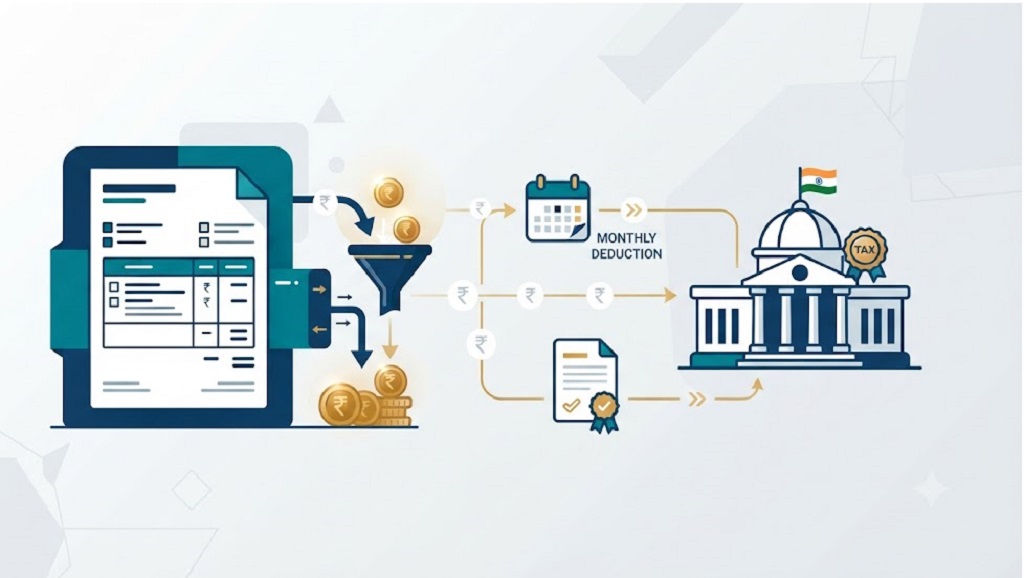
Every payday, a chunk of your salary disappears before it even reaches your bank account. If you’ve ever squinted at your payslip wondering why your ‘in-hand’ number is smaller than your offer letter promised, TDS on salary is usually the answer. It’s not a penalty, and it’s not your employer being stingy — it’s simply how India collects income tax throughout the year instead of asking you for one massive payment in March.
This guide walks you through exactly how TDS on salary works for FY 2026-27, including a major structural change that came into effect this year and that most articles online still haven’t updated.
What Is TDS on Salary?
TDS (Tax Deducted at Source) is a system under which your employer deducts a part of your salary every month and deposits it with the government on your behalf. Instead of paying your entire annual tax liability in a single payment, you pay it in smaller monthly amounts through TDS. This approach makes tax payments easier to manage throughout the financial year.
Previously, Section 192 of the Income Tax Act, 1961 governed TDS on salary. However, the Income-tax Act, 2025 now contains the relevant provisions. We’ll explain this change in the next section.
Who Is Liable to Deduct TDS on Salary?
Every employer must deduct TDS from an employee’s salary if the employee’s estimated annual income exceeds the basic exemption limit. This rule applies to private companies, government departments, partnership firms, and individual employers. Company size does not matter. Even a small startup with five employees must deduct TDS when the employee’s taxable income crosses the exemption threshold.
Latest Update: What Changed from April 2026
Here’s something worth paying close attention to, since it directly affects how your Form 16 and TDS certificates will now read. Starting 1 April 2026, the Income Tax Act, 2025 replaced the old Income Tax Act, 1961, and this brought a renumbering of familiar provisions.
| What Changed | Old Rule | New Rule (from FY 2026-27) |
| TDS on salary section | Section 192 | Section 392 |
| Declaration for no-TDS eligibility | Form 15G / Form 15H | Form 121 |
| Annual tax statement | AIS (old format) | Form No. 168 (new format, FY 2026-27 onward) |
A few practical points follow from this shift:
- Salary paid up to March 2026 continues to be governed by the old Section 192 framework, even if the TDS return correction happens later.
- Salary paid from April 2026 onward falls under the new Section 392.
- If you previously submitted Form 15G or 15H to avoid TDS on low income, you’ll now need to use Form 121 instead, since the old forms have been officially replaced.
- Your tax credit statement for FY 2026-27 will now appear as Form No. 168, separate from the older AIS format used for previous years.
This transition period can occasionally cause mismatches — for instance, if your employer’s payroll software hasn’t fully updated its section codes. If your Form 26AS or Form 168 shows something unexpected, it’s worth flagging with HR early rather than waiting until ITR season.
Income Tax Slabs Used for TDS Calculation (FY 2026-27)
Since TDS is essentially your annual tax liability divided across months, it directly depends on which slab your income falls into. If you want the complete breakdown with all the surcharge and cess details, our income tax slabs 2026-27 guide covers both regimes in depth. Here’s a quick snapshot for context:
| Regime | Basic Exemption | Top Rate |
| New Tax Regime (default) | ₹4,00,000 | 30% above ₹24,00,000 |
| Old Tax Regime (optional) | ₹2,50,000 | 30% above ₹10,00,000 |
How TDS on Salary Is Calculated (Average Rate Method)
Many employees find TDS calculation confusing. Let’s simplify it with a simple example. Imagine your annual tax liability as a full pizza. Instead of paying the entire amount at once, your employer divides it into 12 equal monthly slices. Each slice represents the TDS deducted from your salary every month.
Step-by-Step Formula
Your employer follows these steps to calculate TDS:
- Estimate your total annual salary.
- Subtract eligible deductions and exemptions, such as the standard deduction, HRA, and deductions under Section 80C (where applicable under your chosen tax regime).
- Calculate your tax based on the applicable income tax slabs.
- Add the 4% Health and Education Cess.
- Divide the total annual tax by the remaining months in the financial year to determine the monthly TDS amount.
Average Rate Method
The employer calculates the average tax rate using this formula:
Average Tax Rate = Total Estimated Tax ÷ Total Estimated Annual Income
The employer then applies this average tax rate to each monthly salary payment to deduct TDS.
TDS Calculation Examples — Old vs New Regime
Numbers always make this clearer, so here are three quick scenarios.
Example 1 — ₹6 Lakh Annual Salary
Under the new regime, after the ₹75,000 standard deduction, taxable income drops to ₹5,25,000. Since this falls within the Section 87A rebate threshold, tax liability becomes nil, and consequently, monthly TDS is also zero.
Example 2 — ₹12 Lakh Annual Salary
After the standard deduction, taxable income is ₹11,25,000. Since this is within the ₹12,00,000 rebate limit under the new regime, tax works out to zero, meaning no TDS gets deducted monthly.
Example 3 — ₹15 Lakh Annual Salary
Under the new regime, annual tax (after standard deduction) comes to roughly ₹1,27,500 plus cess, which works out to approximately ₹11,050 deducted monthly. Under the old regime, assuming ₹2 lakh in deductions, annual tax is around ₹1,95,000, translating to roughly ₹16,900 monthly TDS — noticeably higher in this case.
TDS on Different Salary Components
Not every part of your CTC gets taxed the same way, which is why TDS calculation isn’t always a flat percentage of gross pay:
- Basic salary and DA: Fully taxable, forms the core of TDS calculation.
- HRA: Partly exempt (old regime only), based on rent paid and city of residence.
- Bonus and incentives: Fully taxable in the month of payment.
- Notice period recovery: Not taxable, since it’s a deduction rather than income; TDS doesn’t apply here.
- Perquisites (car, accommodation, etc.): Taxable at valuation rates prescribed under the Act.
Salary from More Than One Employer
If you switch jobs mid-year, both employers may not know your combined annual income. This often causes under-deduction of TDS. The safest approach: declare your previous employer’s salary details to your new employer using Form 12B. This lets the new employer calculate TDS on your combined income, not just the new role’s salary.
When Is No TDS Deducted?
TDS doesn’t apply in every situation. Common exceptions include:
- Your estimated annual income falls below the basic exemption limit.
- You qualify for the Section 87A rebate, bringing your tax liability to zero (as shown in Examples 1 and 2 above).
- You’ve submitted the relevant no-deduction declaration — now Form 121 — where eligible.
Role of Exemptions and Deductions in Reducing TDS
Exemptions Considered by Employer
HRA and LTA are automatically factored in by your employer, provided you’ve submitted the relevant proofs (rent receipts, travel bills) before the payroll cutoff, typically in January or February.
Deductions Declared by Employee
Section 80C investments (PPF, ELSS, life insurance), Section 80D health insurance premiums, and home loan interest under Section 24(b) all reduce your taxable income — but only if declared to your employer through an investment declaration form.
The Power of Form 12BB
Form 12BB is essentially your annual opportunity to tell your employer, “Here’s what I’m investing in, please adjust my TDS accordingly.” Submitting it accurately and on time — usually before the final quarter of the financial year — ensures your employer doesn’t over-deduct TDS based on assumptions. Many employees skip this step or submit incomplete proofs, which is often the single biggest reason their monthly take-home feels lower than expected.
Employer’s TDS Compliance Responsibilities
Employers aren’t just deducting TDS arbitrarily; they’re bound by strict compliance timelines:
| Compliance Task | Due Date |
| Monthly TDS deposit | 7th of the following month |
| TDS deposit for March | 30th April |
| Form 24Q (quarterly TDS return) | Within one month of quarter-end |
| Form 16 issuance | By 15th June of the following FY |
Form 24Q has two components — Annexure I, which is mandatory every quarter, and Annexures II & III, which contain the full annual salary breakup and are mandatory only in the fourth quarter’s filing.
What If Excess or Insufficient TDS Is Deducted?
If your employer deducts more TDS than your actual liability, you don’t lose that money — you simply claim it back as a refund while filing your ITR. On the other hand, if TDS deducted falls short of your actual liability (common when you have income from other sources), you’ll need to pay the balance as self-assessment tax before filing your return.
How to Check TDS Deducted on Your Salary
You can verify your TDS credits anytime through Form 26AS or the newer Form No. 168 on the income tax e-filing portal. Check this quarterly instead of waiting until March. This way, you can fix any mismatch with your employer well before filing season.
How to Reduce TDS on Salary Legally
- Submit your investment declaration and Form 12BB proofs early and completely.
- Choose the tax regime that genuinely suits your deduction profile at the start of the financial year.
- Claim HRA if you’re paying rent, even if you haven’t done so before.
- Contribute to NPS for an additional deduction under Section 80CCD(1B), available exclusively under the old regime.
Consequences of Non-Compliance (Employer Penalties)
Employers who deduct TDS late or fail to deposit it on time face interest charges — 1% per month for late deduction and 1.5% per month for late deposit. Delayed filing of Form 24Q also attracts penalties under the Act, and repeated non-compliance can result in the employer being treated as an “assessee in default.”
TDS vs Advance Tax: Key Difference
Your employer deducts TDS from your salary throughout the financial year. In contrast, you pay advance tax yourself when you earn significant income outside your salary, such as freelance income, rental income, or capital gains that your employer does not include while calculating TDS. If you earn income only from your salary, you usually do not need to pay advance tax because TDS already covers your tax liability.
Frequently Asked Questions
Can I stop TDS deduction from my salary?
Only if your estimated annual income falls below the taxable threshold or you qualify for a full rebate under Section 87A. You'll need to submit the appropriate declaration, now called Form 121.
What happens if my employer deducts wrong TDS?
Raise it with your payroll or HR team immediately, since incorrect deduction can lead to mismatches in your Form 26AS or Form 168. If it's not corrected before filing, you can still reconcile the difference in your ITR.
Is Form 15G/15H still valid, or has it been replaced?
For FY 2026-27 onward, Form 15G and Form 15H have been replaced by Form 121 under the new Income Tax Act, 2025.
How can I check how much TDS has been deducted so far?
Log in to the income tax e-filing portal and check Form 26AS (for older periods) or Form No. 168 (for FY 2026-27), both of which reflect real-time TDS credits against your PAN.
Can I switch tax regimes to change my TDS mid-year?
Generally, you inform your employer of your regime choice at the start of the financial year, and it applies to TDS calculation for that year. However, you can still choose a different regime when filing your ITR, regardless of what was used for monthly TDS.
Is TDS deducted on notice period recovery?
No, since notice period recovery is a deduction from your final settlement rather than income, it does not attract TDS.
Conclusion
TDS on salary might seem like just another line item on your payslip but understanding how it actually works puts you in a much stronger position — both to plan your monthly cash flow and to avoid surprises at tax filing time. With Section 392 now replacing the familiar Section 192, and Form 121 stepping in for the old 15G/15H declarations, FY 2026-27 brings a genuine shift in terminology even though the underlying logic remains familiar.
For official rules and updates, you can refer to the Income Tax Department’s official website.


1 comment