Bank PO/Clerk Salary in India 2026: In-Hand Pay, Perks & Career Growth

Every year, lakhs of aspirants sit for IBPS and SBI exams chasing one dream: a stable government banking job. Yet surprisingly few candidates actually understand what their bank PO clerk salary looks like once deductions kick in, or how dramatically the numbers differ between a Probationary Officer and a Clerk. This guide breaks down exactly what you’ll take home in 2026, across every major banking exam.
We’ll cover pay scales, allowances, deductions, and the career growth path from Clerk all the way up to senior management.
Bank PO vs Clerk: What’s the Real Difference?
A Probationary Officer (PO) enters the bank at the officer level, specifically Junior Management Grade Scale-I (JMGS-I), and typically handles credit appraisal, branch management, and supervisory responsibilities from day one. A Clerk, formally called a Customer Service Associate (CSA), works at the clerical level, primarily handling day-to-day customer transactions, account opening, and cash handling. Both roles require clearing separate IBPS or SBI exams, and naturally, the PO role commands a significantly higher salary given its supervisory scope.
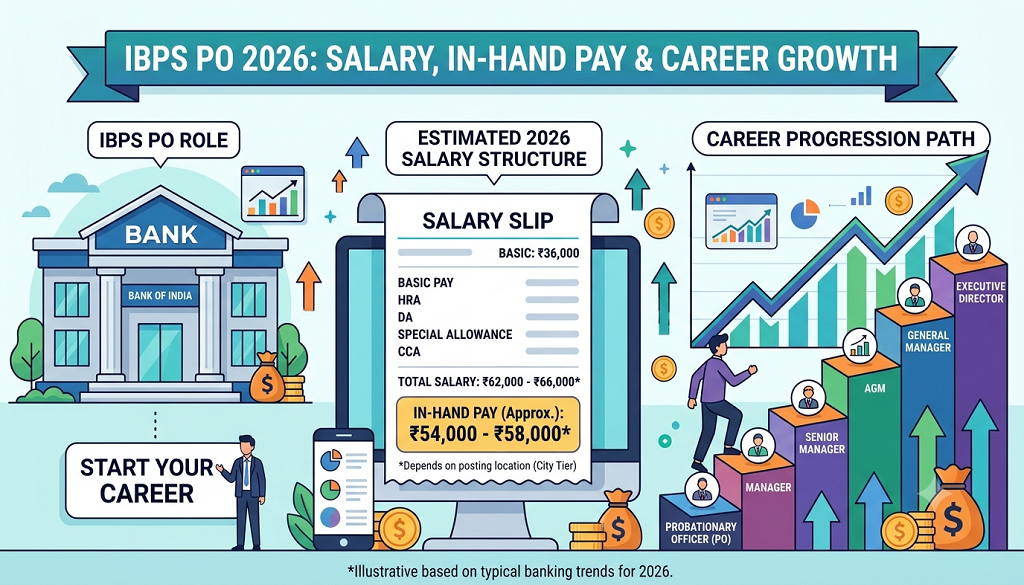
IBPS PO Salary 2026: Pay Scale & In-Hand
The starting basic pay for an IBPS PO in 2026 stands at ₹48,480 per month under the revised Bipartite Settlement. Once you add Dearness Allowance, House Rent Allowance, and other components, gross monthly salary typically falls between ₹72,000 and ₹78,000.
| Component | Approximate Monthly Amount |
| Basic Pay | ₹48,480 |
| Dearness Allowance (DA) | ₹10,700 (quarterly revised) |
| House Rent Allowance (HRA) | ₹4,360 – ₹4,850 (city-dependent) |
| City Compensatory Allowance (CCA) | ₹720 – ₹1,000 |
| Special Allowance | ₹6,500 – ₹7,500 |
| Gross Salary | ₹72,000 – ₹78,000 |
After statutory deductions like NPS, professional tax, and income tax, the actual in-hand salary of an IBPS PO in 2026 usually settles between ₹65,000 and ₹72,000 per month, with the exact figure depending on posting location.
IBPS PO Salary During Training and Probation
Newly selected IBPS POs undergo a probation period, typically lasting one to two years, and receive their full basic pay along with applicable allowances right from the start, unlike some clerical roles where training-period pay differs slightly from the confirmed salary.
SBI PO Salary 2026: Pay Scale & In-Hand
SBI PO also starts with a basic pay of ₹48,480, matching IBPS PO at the entry point. However, SBI’s gross salary climbs noticeably higher, typically between ₹93,000 and ₹95,000 monthly, primarily because SBI offers a richer special allowance component along with additional perquisites like subsidized or leased accommodation in many postings.
After deductions, SBI PO’s in-hand salary generally falls between ₹80,000 and ₹85,000 per month, making it one of the most attractive entry-level officer packages among public sector banks.
IBPS Clerk Salary 2026: Pay Scale & In-Hand
The IBPS Clerk role starts considerably lower, with a basic pay of ₹24,050 per month. Graduate candidates receive two advance increments, pushing their actual starting basic to approximately ₹26,730. Here’s how the pay scale progresses over a full 20-year career:
| Years of Service | Basic Pay Progression |
| Years 1–3 | ₹24,050, rising by ₹1,340 annually |
| Years 4–6 | ₹28,070, rising by ₹1,650 annually |
| Years 7–10 | ₹33,020, rising by ₹2,000 annually |
| Years 11–17 | ₹41,020, rising by ₹2,340 annually |
| Years 18 | ₹57,400, rising by ₹4,400 |
| Year 19 | ₹61,800, rising by ₹2,680 |
| Year 20 (maximum) | ₹64,480 |
Once DA, HRA, and Special Allowance get added, gross salary for an IBPS Clerk typically ranges between ₹40,000 and ₹47,000 monthly, translating to an in-hand salary of roughly ₹39,000 to ₹43,000 after deductions.
IBPS Clerk Training Period Salary
Selected candidates undergo a six-month training period, during which they receive a stipend equal to their starting basic pay, approximately ₹24,050 to ₹26,730 depending on graduate increments. This training period may extend slightly based on individual performance or the bank’s internal requirements.
Bank PO vs Clerk: Side-by-Side Salary Comparison
| Metric | IBPS PO | SBI PO | IBPS Clerk |
| Starting Basic Pay | ₹48,480 | ₹48,480 | ₹24,050 – ₹26,730 |
| Gross Monthly Salary | ₹72,000 – ₹78,000 | ₹93,000 – ₹95,000 | ₹40,000 – ₹47,000 |
| In-Hand Monthly Salary | ₹65,000 – ₹72,000 | ₹80,000 – ₹85,000 | ₹39,000 – ₹43,000 |
| Promotion to Next Level | 3–4 years typical | 3–4 years typical | 2–3 years for internal PO exam eligibility |
If you’re comparing this against private-sector compensation, it helps to understand exactly how CTC translates to take-home pay. Our CTC vs Salary guide explains this conversion clearly, and our 10 LPA In-Hand Salary guide shows how a comparable private-sector package breaks down for reference.
What’s Included in Gross Salary? (Allowances Explained)
- Dearness Allowance (DA): Revised quarterly based on the Consumer Price Index for Industrial Workers (CPI-IW), and currently sits around 22% of basic pay.
- House Rent Allowance (HRA): Varies by posting location — typically 9% for metro cities, 8% for urban centers, and 7% for smaller towns.
- City Compensatory Allowance (CCA): A smaller top-up specifically for urban and metro postings.
- Special Allowance: A significant component, particularly generous at SBI compared to other IBPS-affiliated banks.
- Medical Allowance and LTC: Additional benefits that don’t always reflect in monthly in-hand but add real value over the year.
Deductions From Bank PO/Clerk Salary
- National Pension System (NPS): A mandatory contribution that also builds long-term retirement savings.
- Professional Tax: A small state-specific deduction, similar to what private-sector employees also pay.
- Income Tax (TDS): Applies based on your total taxable income and chosen tax regime.
For a complete breakdown of how income tax actually gets calculated on your salary, our Income Tax Slabs 2026-27 guide walks through both regimes with worked examples.
Perks and Benefits Beyond Salary
- Pension under NPS, providing long-term financial security well beyond your working years.
- Comprehensive medical benefits for employees and, in many cases, their dependent family members.
- Leave Travel Concession (LTC), covering periodic travel expenses.
- Subsidized or leased accommodation, particularly common at the PO level in select postings.
- Generous paid leave policies compared to many private-sector roles.
Career Growth Path: Clerk to PO to Manager
Bank clerks aren’t stuck at the clerical level forever. After completing 2-3 years of service, clerks become eligible to appear for internal promotional exams that can elevate them directly to Officer Scale I, essentially the same level as a fresh IBPS PO recruit. From there, the growth path continues through Scale II, Scale III, and eventually into senior management and General Manager roles, based on a mix of seniority, performance, and further internal examinations.
Bank PO/Clerk Salary: City-Wise Variation
Since HRA and CCA both depend on your posting location, the same designation can produce a noticeably different in-hand salary depending on where you’re posted. Metro postings generally offer the highest HRA percentage, while rural postings offer the lowest HRA but sometimes include additional rural allowances to help offset the difference.
| Posting Type | Typical HRA % | Effect on Take-Home |
| Metro (population 45L+) | ~9% of basic pay | Highest HRA, but also highest cost of living |
| Urban (population 10L–45L) | ~8% of basic pay | Moderate HRA, balanced cost of living |
| Semi-Urban/Rural | ~7% of basic pay | Lowest HRA, though living costs are also lower |
Consequently, a PO or Clerk posted in a metro city doesn’t necessarily end up with more disposable income than a colleague posted in a smaller town, since rent and daily expenses in metros typically rise faster than the HRA difference compensates for.
Is Bank PO/Clerk a Good Career Choice in 2026?
Yes, for candidates prioritizing job security, pension benefits, and a clear promotion pathway, bank PO and clerk roles remain genuinely attractive in 2026. While private-sector roles at comparable experience levels can sometimes offer higher starting pay, few match the long-term stability, structured career progression, and post-retirement benefits that public sector banking provides. The PO role, in particular, offers a compelling mix of respectable starting pay and strong long-term growth potential.
Frequently Asked Questions
What is the in-hand salary of IBPS Clerk in 2026?
Approximately ₹39,000 to ₹43,000 per month, after standard deductions from the gross salary.
Is SBI PO salary higher than IBPS PO?
Yes, SBI PO offers a noticeably higher gross and in-hand salary, primarily due to a more generous special allowance and additional perquisites like leased accommodation.
What is the salary during the IBPS Clerk training period?
Selected candidates receive a stipend equal to their starting basic pay, approximately ₹24,050 to ₹26,730, during the six-month training period.
How long does it take for a Clerk to become a PO?
Clerks typically become eligible for internal promotional exams after 2-3 years of service, which can elevate them directly to Officer Scale I.
Is bank PO/clerk salary enough to live in metro cities?
Yes, particularly for PO roles, since higher HRA in metro postings helps offset increased living costs. Clerk salaries require more careful budgeting in expensive metros but remain manageable.
Do bank POs and clerks get a pension?
Yes, both roles contribute to the National Pension System (NPS), which builds retirement savings over the course of their banking career.
Conclusion
Your bank PO clerk salary ultimately depends on which role and which bank you join, but both paths offer something private-sector jobs rarely match genuine long-term security paired with a clear, structured promotion ladder. Whether you’re aiming for the higher starting pay of an SBI PO or the steady, secure growth of an IBPS Clerk role, understanding these numbers upfront helps you set realistic expectations and plan your finances accurately from day one.
For official notifications and pay scale updates, you can refer to the IBPS official website.


3 comments