What is CTC in Salary? Meaning, Components & Calculation (2026)
When you receive a job offer, one of the first terms you will see is CTC. Many people feel excited when they see a large salary figure. However, the number mentioned in the offer letter is often not the exact money you receive every month.
That number usually represents the Cost to Company (CTC).
Understanding what is CTC helps employees know how their salary is structured. It also helps them understand the difference between the offered salary and the actual money they take home.
In India, companies commonly present compensation packages as CTC. This structure helps employers calculate the total cost of hiring an employee, including salary, benefits, and contributions.
For job seekers, especially fresh graduates, understanding CTC prevents confusion during salary discussions.
What is CTC (Cost to Company)?
CTC stands for Cost to Company. It represents the total amount a company spends on an employee in a year.
This includes not only the salary but also benefits, bonuses, and employer contributions.
Simple Definition
CTC is the total cost incurred by a company for employing an individual.
It includes:
-
Basic salary
-
Allowances
-
Bonuses
-
Insurance benefits
-
Retirement contributions
However, the key point to remember is this:
CTC is not the same as take-home salary.
Some components included in CTC are not paid directly to employees in cash.
Example
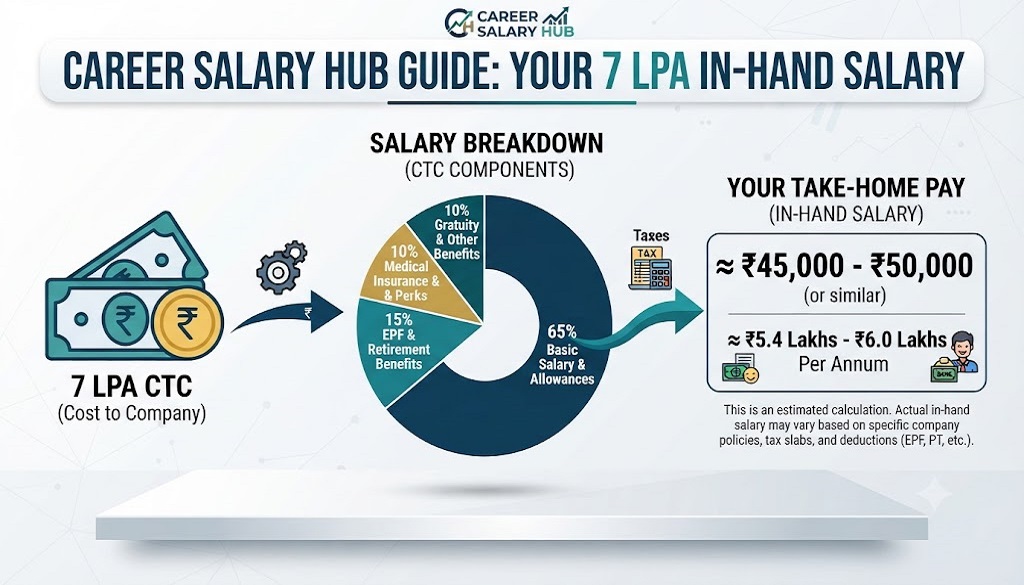
Suppose a company offers a CTC of ₹8,00,000 per year.
The employee may actually receive only ₹45,000–₹50,000 per month after deductions and employer contributions.
That is why understanding what is CTC in salary is important before accepting a job offer.
Key Components of CTC
The salary package is usually divided into several components. These components help companies structure compensation efficiently and comply with tax regulations.
Let’s explore the major components of CTC.
Fixed Salary Components
These components form the stable portion of your salary. They are usually paid every month.
1. Basic Salary
Basic salary is the core component of your salary.
Most other benefits are calculated as a percentage of the basic salary.
Typical characteristics:
-
Usually 30–50% of total salary
-
Fully taxable
-
Used to calculate PF and gratuity
2. House Rent Allowance (HRA)
HRA helps employees cover housing expenses.
Employees living in rented houses can claim tax benefits on HRA.
Typical HRA percentage:
| City Type | HRA Percentage |
|---|---|
| Metro cities | 40–50% of basic salary |
| Non-metro cities | 30–40% of basic salary |
3. Dearness Allowance (DA)
Dearness Allowance helps employees deal with inflation and rising living costs.
It is more common in government jobs but may also appear in private sector packages.
4. Conveyance Allowance
This allowance covers commuting expenses.
Examples include:
-
Fuel expenses
-
Public transportation costs
-
Office commute
5. Special Allowances
Special allowances are flexible salary components added by companies.
Examples include:
-
Internet allowance
-
Telephone allowance
-
Work-from-home allowance
These allowances are usually fully taxable.
Variable Pay and Bonuses
Variable pay depends on company performance or individual performance.
Employees may receive these payments quarterly or annually.
Examples include:
-
Performance bonus
-
Sales incentives
-
Profit-sharing rewards
-
Annual bonus
Important note:
Variable pay is not guaranteed income. It depends on targets and company policies.
Employer Contributions and Benefits
Companies also include several long-term benefits in the CTC package.
These benefits improve employee security and financial stability.
Provident Fund (PF)
The Employer Provident Fund contribution is usually:
-
12% of the basic salary
This amount goes into your retirement savings.
Gratuity
Gratuity is a long-term benefit paid to employees who stay in a company for more than five years.
It is calculated based on basic salary and years of service.
Employee State Insurance (ESI)
ESI provides medical coverage to employees with lower salaries.
Benefits include:
-
Medical treatment
-
Disability coverage
-
Maternity benefits
Health Insurance
Many companies provide group health insurance for employees and their families.
This is also included in the total CTC.
How to Calculate CTC
Understanding how to calculate CTC helps you analyze job offers more effectively.
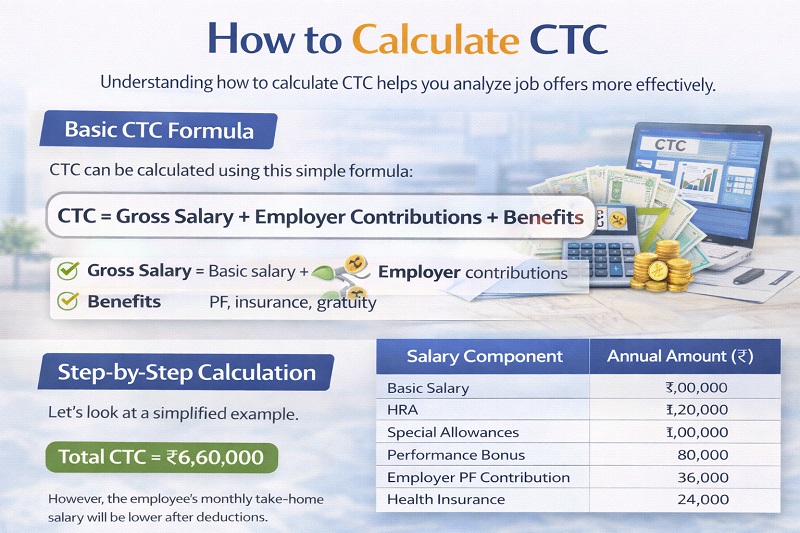
Basic CTC Formula
CTC can be calculated using this simple formula:
CTC = Gross Salary + Employer Contributions + Benefits
Where:
-
Gross Salary = Basic salary + allowances
-
Employer contributions = PF, insurance, gratuity
-
Benefits = bonuses and perks
Step-by-Step Calculation
Let’s look at a simplified example.
| Salary Component | Annual Amount (₹) |
|---|---|
| Basic Salary | 3,00,000 |
| HRA | 1,20,000 |
| Special Allowances | 1,00,000 |
| Performance Bonus | 80,000 |
| Employer PF Contribution | 36,000 |
| Health Insurance | 24,000 |
Total CTC = ₹6,60,000
However, the employee’s monthly take-home salary will be lower after deductions.
Example of CTC Breakdown
Let’s understand a realistic salary structure.
Imagine an employee receives ₹10 LPA CTC.
Sample Breakdown
| Component | Amount (₹) |
|---|---|
| Basic Salary | 4,00,000 |
| HRA | 1,60,000 |
| Allowances | 1,40,000 |
| Bonus | 1,00,000 |
| PF Contribution | 48,000 |
| Gratuity | 19,200 |
| Insurance | 32,800 |
Total = ₹10,00,000
But after taxes and deductions, the employee may receive about ₹65,000–₹70,000 per month.
This example clearly shows why knowing what is CTC helps employees understand their real income.
Also read: Gross Salary vs Net Salary
CTC vs Gross Salary vs Net Salary
Many people confuse these three salary terms.
Understanding their differences makes salary negotiations easier.
| Salary Type | Meaning |
|---|---|
| CTC | Total cost spent by employer |
| Gross Salary | Salary before deductions |
| Net Salary | Actual take-home salary |
Gross Salary
Gross salary includes:
-
Basic salary
-
Allowances
-
Bonuses
But it does not include employer contributions.
Net Salary (Take-Home Salary)
Net salary is the amount employees receive in their bank account.
Deductions include:
-
Income tax
-
Provident Fund
-
Professional tax
Why Your Take-Home Salary is Lower Than CTC
Many employees feel confused when their in-hand salary is lower than expected.
Here are the main reasons.
1. Employer Contributions
Some parts of CTC are paid to government schemes or insurance plans.
Examples include:
-
PF contributions
-
Gratuity
-
Insurance premiums
2. Statutory Deductions
Mandatory deductions include:
-
Income tax
-
Professional tax
-
PF employee contribution
3. Variable Pay
Some bonuses depend on performance.
If targets are not met, employees may not receive the full amount.
Why CTC Matters for Employees and Employers
Understanding what is CTC benefits both employees and companies.
For Employees
-
Helps evaluate job offers
-
Improves salary negotiation
-
Clarifies compensation structure
For Employers
-
Provides transparent salary packages
-
Simplifies payroll planning
-
Helps manage compensation budgets
Common Misconceptions About CTC
Many job seekers misunderstand the concept of CTC.
Here are common myths.
Myth 1: CTC equals take-home salary
Reality: CTC includes employer contributions and benefits.
Myth 2: All CTC components are paid in cash
Reality: Some benefits are indirect, such as insurance or PF.
Myth 3: Higher CTC means higher monthly salary
Reality: Salary structure determines the actual take-home amount.
Tips to Understand Your Salary Structure
Before accepting a job offer, review your salary breakdown carefully.
Here are some practical tips.
1. Always check the salary breakup
Ask HR for a detailed salary structure.
2. Understand deductions
Important deductions include:
-
PF
-
Income tax
-
Professional tax
3. Evaluate variable pay
Check how much of your salary depends on performance.
4. Compare take-home salary
Focus on monthly in-hand salary, not just CTC.
FAQs About CTC
What is expected CTC?
Expected CTC is the salary amount a job candidate expects from an employer.
It is usually mentioned during interviews.
What is fixed CTC and variable CTC?
Fixed CTC: Guaranteed salary components
Variable CTC: Performance-based pay
What is the difference between CTC and LPA?
CTC: Total compensation offered
LPA: Salary expressed in lakhs per year
Example: ₹6 LPA means ₹6,00,000 annual salary.
What percentage of salary is basic pay in CTC?
Basic salary usually ranges between 30% and 50% of total CTC.
Conclusion
Understanding what is CTC is important for anyone stepping into the job market or evaluating a new job offer. CTC represents the total amount a company spends on an employee, including salary, benefits, bonuses, and employer contributions.
However, it’s important to remember that CTC is not the same as your monthly take-home salary. Several components such as taxes, provident fund contributions, and other deductions affect the final amount that reaches your bank account.
Before accepting any offer, job seekers should carefully review the complete salary breakdown. Learning the difference between CTC, gross salary, and take-home salary allows professionals to better evaluate offers and negotiate compensation confidently.
For more career guidance and salary insights, platforms like Career Salary Hub can help job seekers understand salary structures, industry pay trends, and smarter ways to plan their professional growth.


17 comments