Gross Salary vs Net Salary: What You Need to Know for Financial Clarity

If you’ve ever received a job offer or looked at your monthly payslip and wondered why your take-home amount is lower than expected, you’re not alone. The confusion usually comes down to one important topic: gross salary vs net salary.
Understanding these salary terms is not just useful — it’s essential. It impacts:
-
Your monthly budget
-
Your tax planning
-
Your investment decisions
-
Your salary negotiations
Many employees focus only on the headline number mentioned in an offer letter. But what truly matters is what actually lands in your bank account.
Let’s break this down in simple, practical terms.
What is Gross Salary?
Gross salary is the total salary you earn before any deductions are made.
It includes:
-
House Rent Allowance (HRA)
-
Special allowances
-
Bonuses
-
Performance incentives
-
Other company-provided allowances
Think of gross salary as the “full package” offered by your employer before taxes and other deductions are applied.
Components of Gross Salary
Here’s what typically makes up your gross salary:
1. Basic Salary
This is the fixed core portion of your pay. Most other benefits are calculated as a percentage of this amount.
2. HRA (House Rent Allowance)
Given to employees to cover rental expenses.
3. Special Allowance
Extra fixed component added to balance the salary structure.
4. Bonuses & Incentives
Performance-based payments.
5. Other Allowances
-
Travel allowance
-
Medical allowance
-
Communication allowance
Gross Salary Formula
Example of Gross Salary Calculation
Let’s assume:
-
Basic Salary: ₹30,000
-
HRA: ₹10,000
-
Special Allowance: ₹5,000
-
Bonus: ₹5,000
Gross Salary = ₹50,000 per month
This is the amount before deductions.
What is Net Salary?
Net salary is the amount you actually receive in your bank account after deductions.
It is also called:
-
Take-home salary
-
In-hand salary
In simple terms:
Net Salary = What you actually take home.
Common Deductions from Gross Salary
Some common deductions include:
Income Tax (TDS) – as per the official Income Tax Department of India guidelines.
-
Provident Fund (PF)
-
Professional Tax
-
Employee State Insurance (ESI)
-
Health insurance premiums
Net Salary Formula
Example of Net Salary Calculation
Using the previous gross salary of ₹50,000:
-
PF deduction: ₹3,600
-
Income Tax (TDS): ₹4,000
-
Professional Tax: ₹200
Total deductions = ₹7,800
Net Salary = ₹50,000 – ₹7,800 = ₹42,200
That ₹42,200 is your actual take-home pay.
Key Differences Between Gross Salary and Net Salary
Understanding the difference between gross salary vs net salary becomes much easier with a comparison table.
| Basis | Gross Salary | Net Salary |
|---|---|---|
| Meaning | Total earnings before deductions | Earnings after deductions |
| Includes | Basic pay + allowances + bonuses | Final take-home amount |
| Tax Deducted? | No | Yes |
| Higher or Lower? | Always higher | Always lower |
| Mentioned in Offer Letter? | Usually yes | Rarely |
Impact on Take-Home Pay
Gross salary looks impressive.
Net salary determines your lifestyle.
This is why job offers should always be evaluated based on net pay, not just the gross figure.
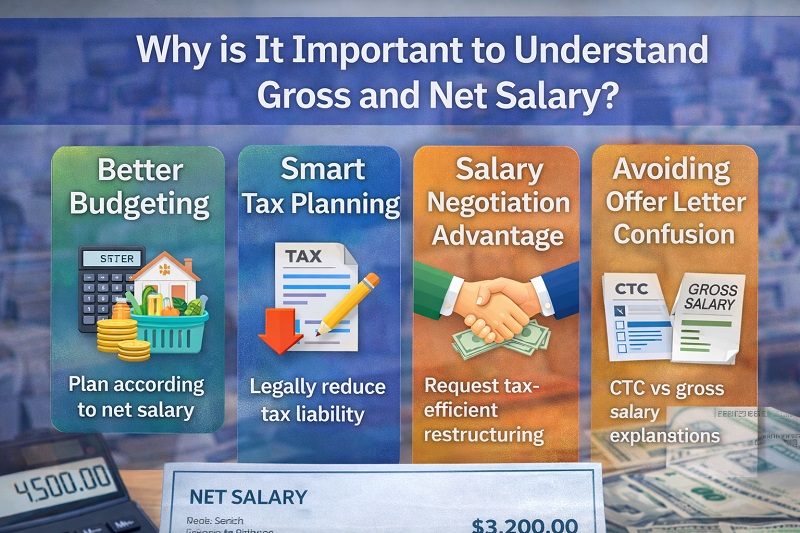
Why is It Important to Understand Gross and Net Salary?
Many professionals overlook this — and it can cost them financially.
1. Better Budgeting
Your EMI, rent, groceries, and investments should be planned according to net salary.
2. Smart Tax Planning
Knowing deductions helps you legally reduce tax liability.
3. Salary Negotiation Advantage
When negotiating, you can request tax-efficient restructuring.
4. Avoiding Offer Letter Confusion
Sometimes companies highlight CTC instead of gross salary, which creates misunderstanding.
Gross Salary vs CTC vs Net Salary
Another common confusion in the gross salary vs net salary debate is CTC.
What is CTC (Cost to Company)?
CTC is the total cost a company spends on you annually.
It may include:
-
Gross salary
-
Employer’s PF contribution
-
Gratuity
-
Insurance premiums
Quick Comparison
| Component | Meaning |
|---|---|
| CTC | Total company cost |
| Gross Salary | Earnings before deductions |
| Net Salary | Take-home salary |
CTC is usually higher than gross salary.
How Are Taxes and Deductions Calculated?
Deductions vary depending on:
-
Country
-
Salary bracket
-
Tax regime
-
Company policy
Common Deductions Breakdown
You can check updated tax slabs on the official Income Tax Portal.
-
PF (usually 12% of basic salary)
-
Professional Tax (state-based)
-
ESI (if applicable under salary limits)
Example:
If basic salary = ₹30,000
PF = 12% of ₹30,000 = ₹3,600
How to Calculate Your Net Salary from Gross Salary
Here’s a simple step-by-step guide:
Step 1: Identify Gross Salary
Example: ₹60,000 per month
Step 2: Calculate Mandatory Deductions
-
PF (12% of basic)
-
Income tax (as per slab)
-
Professional tax
Step 3: Subtract Total Deductions
If total deductions = ₹10,000
Net Salary = ₹60,000 – ₹10,000 = ₹50,000
That’s your take-home amount.
Common Misconceptions About Gross vs Net Salary
Myth 1: Gross Salary = Take Home Pay
False. Deductions always apply.
Myth 2: Higher CTC Means Higher Net Salary
Not necessarily. Benefits and employer contributions inflate CTC.
Myth 3: Net Salary is Fixed
It may change based on tax-saving investments.
Why Net Salary is Lower Than Gross Salary?
The difference exists because of:
-
Government taxes
-
Social security contributions
-
Insurance premiums
-
Company benefit structures
It’s not a “hidden cut” — it’s part of legal compliance.
How to Increase Your Net Salary?
Here are practical tips:
1. Use Tax-Saving Investments
-
Section 80C investments
-
Health insurance
-
Home loan benefits
2. Salary Restructuring
Ask HR to optimize allowances.
3. Negotiate Smartly
Focus on in-hand salary, not just CTC.
Example: Monthly and Annual Calculation
Monthly Example
Gross Salary: ₹70,000
Total Deductions: ₹12,000
Net Salary: ₹58,000
Annual Example
Gross Annual Salary: ₹8,40,000
Annual Deductions: ₹1,44,000
Net Annual Salary: ₹6,96,000
FAQs
Is gross salary before tax?
Yes. Gross salary is calculated before tax deductions.
Is net salary same as take-home salary?
Yes, both terms mean the same.
Which salary is mentioned in offer letters?
Usually gross salary or CTC is mentioned.
Is gross salary taxable?
Yes, income tax is calculated based on your gross income (after applicable exemptions).
Conclusion
Understanding the difference between gross salary and net salary is essential for smart financial planning and confident salary negotiations. When you know exactly how much you’ll take home, it becomes much easier to budget, plan savings, and avoid unpleasant surprises later.
For practical salary guides, pay comparisons, and career insights, explore career Salary Hub to better understand how different roles, industries and locations can impact your real take-home pay.
Before accepting any job offer, always review your gross and net salary breakdown carefully and make sure it aligns with your long-term financial goals. Taking a few minutes to research now can make a big difference to your career and income decisions later.




3 comments