Railway Group D Salary 2026: In-Hand Pay & Post-Wise Breakdown

Every recruitment cycle, Indian Railways receives applications from millions of candidates for Group D posts, making it genuinely one of the most sought-after government job categories in the country. Naturally, though, most aspirants only have a rough idea of their actual Railway Group D salary once they clear the exam and join. Therefore, this guide breaks down exactly what you’ll take home, along with a perk that genuinely sets Railway jobs apart from every other government post.
Additionally, we’ll cover the same DA and HRA revision that recently reshaped SSC salaries across the board, since it applies here too, and it directly affects your monthly in-hand pay.
Railway Group D Salary 2026: Quick Overview
Railway Group D, recruited through the Railway Recruitment Boards (RRBs), covers Level 1 positions under the 7th Pay Commission, including Track Maintainer, Helper/Assistant, and Pointsman roles across multiple departments. Basic pay starts at ₹18,000 per month, and once you factor in DA, HRA, and other allowances, in-hand salary typically ranges from roughly ₹24,000 to over ₹30,000, depending on your posting city. Since this exam only requires a 10th-pass or ITI qualification, it genuinely draws one of the largest candidate pools among all government recruitment exams in India.
Latest Update: DA at 58%, Revised HRA Rates Apply Here Too
Here’s something worth knowing before calculating your own numbers. Recently, the central government revised Dearness Allowance to 58% of basic pay across all central government and Railway posts alike. Consequently, House Rent Allowance rates moved up too, since DA crossing the 50% threshold automatically triggers an HRA revision under 7th Pay Commission rules.
| City Category | Previous HRA Rate | Current HRA Rate |
| X (Metro cities) | 24% | 27% |
| Y (Mid-sized cities) | 16% | 18% |
| Z (Smaller towns) | 8% | 9% |
Meanwhile, discussions around the 8th Pay Commission continue gaining momentum, and once implemented, it could meaningfully raise the basic pay structure for Group D and similar Pay Level 1 posts. However, since no confirmed implementation date exists yet, it makes sense to plan around current pay scales rather than anticipated future revisions.
Railway Group D Posts and Departments
Railway Group D recruitment spans several departments, each with slightly different day-to-day responsibilities, though pay remains consistent across all of them at Level 1.
For official notifications, exact vacancy details, and recruitment updates, you can always verify details directly on the Railway Recruitment Cell’s official website, since post-wise vacancies do get revised each recruitment cycle.
| Post | Department | Typical Role |
| Track Maintainer Grade-IV | Engineering | Track inspection and maintenance |
| Helper/Assistant | Mechanical, Electrical, S&T | Technical support and maintenance assistance |
| Assistant Pointsman | Traffic | Point and signal operations support |
| Porter/Helper | Commercial | Passenger and goods handling assistance |
Railway Group D Salary Structure: Components Explained
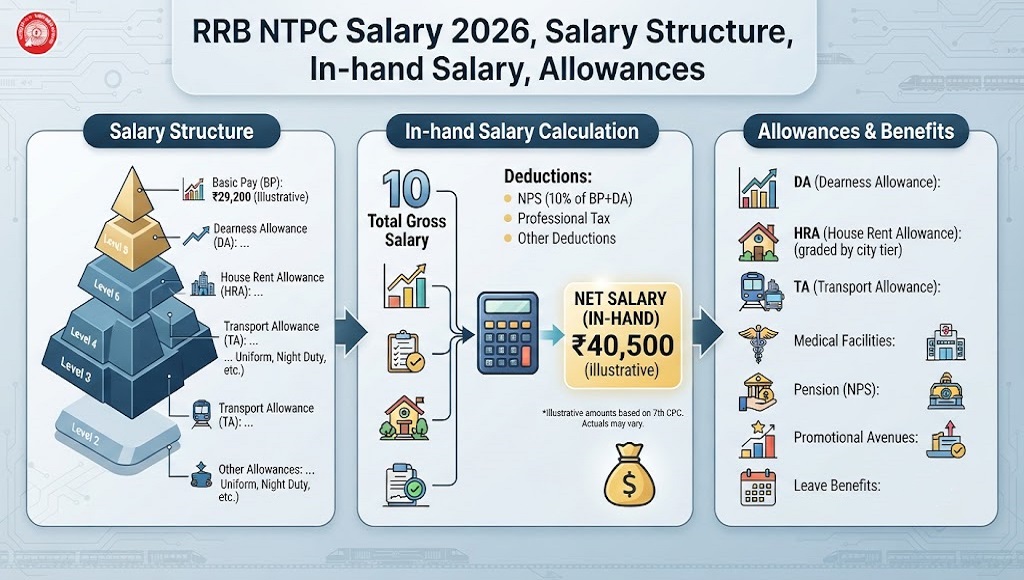
- Basic Pay: Fixed at ₹18,000 per month at entry level.
- Grade Pay: ₹1,800, corresponding to the pre-revised Pay Band structure.
- Dearness Allowance (DA): Currently 58% of basic pay, revised twice yearly.
- House Rent Allowance (HRA): Now 27%, 18%, or 9%, depending on city category.
- Transport Allowance (TA): Varies by posting location, typically between ₹900 and ₹1,350.
- Night Duty Allowance: An additional payment for employees working night shifts, common in operational roles like Pointsman.
Railway Group D In-Hand Salary: City-Wise Breakdown
| City Category | HRA Rate | Approx. In-Hand Salary |
| X (Metro) | 27% | ₹28,000 – ₹30,500 |
| Y (Mid-sized) | 18% | ₹25,500 – ₹27,500 |
| Z (Smaller towns) | 9% | ₹24,000 – ₹25,500 |
If you’re also comparing this against other Pay Level 1 government roles, our SSC MTS Salary guide covers a very similar structure under a different recruiting body.
Railway Group D Deductions: What Reduces Your In-Hand
- National Pension System (NPS): A mandatory contribution building long-term retirement savings.
- Railway Medical Scheme Contribution: A small deduction covering comprehensive medical benefits for employees and dependents.
- CGEGIS (Group Insurance Scheme): A modest, mandatory insurance deduction.
Notably, income tax rarely applies at this salary level, since gross annual income typically falls well within tax-free limits after the standard deduction.
For a broader understanding of how salary structures work outside government roles, our CTC vs Salary guide explains how private-sector compensation differs from this government pay model.
Sample Railway Group D Salary Calculation (X-City)
Let’s work through the actual numbers for a Track Maintainer posted in a metro city.
- Basic Pay: ₹18,000
- DA (58% of Basic): ₹10,440
- HRA (27% of Basic, X-city): ₹4,860
- Transport Allowance: approximately ₹1,350
- Gross Salary: approximately ₹34,500 – ₹35,500
- Less: NPS, medical scheme, and CGEGIS deductions
- Approximate In-Hand: ₹28,000 – ₹30,500
Railway Group D Probation Period
Once selected, candidates typically undergo an initial probation period, usually lasting around two years, before their appointment gets confirmed. Throughout this period, employees receive their full basic pay and applicable allowances, so probation status doesn’t reduce your take-home salary.
Railway Group D Salary After 3, 5, and 10 Years
Your salary certainly doesn’t remain static after joining. Instead, basic pay increases through an annual 3% increment, and periodic DA revisions further boost your gross salary over time.
| Timeline | Approximate In-Hand Salary |
| At Joining | ₹24,000 – ₹30,500 |
| After 3 Years | ₹30,000 – ₹36,000 |
| After 5 Years | ₹34,000 – ₹40,000 |
| After 10 Years (with MACP) | ₹44,000 – ₹52,000+ |
Unique Perks: Free Rail Passes and Beyond
Here’s a benefit that genuinely sets Railway employment apart from nearly every other government job category. Railway Group D employees, along with their families, become eligible for free or heavily concessional rail travel passes, a perk that simply doesn’t exist in SSC, banking, or most other central government roles. Beyond this signature benefit, employees also receive:
- Pension under the National Pension System, ensuring long-term financial security.
- Comprehensive medical coverage through the Railway health scheme, extending to dependent family members.
- Access to Railway quarters or accommodation, where available at certain postings.
- Gratuity upon completing the minimum qualifying service period.
Since gratuity forms part of this benefits package, our Gratuity Rules 2026 guide explains current eligibility and calculation rules in detail.
Career Growth: Promotions From Group D
Fortunately, Group D employees aren’t confined to entry-level positions forever. Through departmental promotions and the Modified Assured Career Progression scheme, a Track Maintainer Grade-IV can progress through Grade III, Grade II, and eventually Grade I, commonly known as Mate or Keyman, taking on greater supervisory responsibility along the way.
Beyond these grade-wise promotions within the same cadre, many employees also use their tenure to prepare for internal departmental exams, which can open pathways into supervisory or technical roles carrying meaningfully higher pay levels. Consequently, a Group D appointment often functions less as a career ceiling and more as a genuine starting platform, provided you stay proactive about upskilling and internal opportunities as they arise.
What Can You Realistically Afford on This Salary?
Since in-hand salary alone doesn’t tell the full story, it helps to translate these numbers into everyday terms. In smaller towns and Z-category cities, an in-hand salary of roughly ₹24,000 to ₹26,000 typically covers comfortable family living, including rent or a housing loan EMI, groceries, and modest savings. In larger X-category cities, where living costs run considerably higher, the same role’s ₹28,000 to ₹30,500 in-hand pay still supports a stable lifestyle, particularly since many Railway postings include access to subsidized quarters, which meaningfully reduces the single biggest household expense most families face.
Additionally, since Railway employees often receive postings across different regions during their career, understanding how HRA and cost of living interact across city categories genuinely helps with long-term financial planning, rather than budgeting around a single number that may shift with your next transfer.
Railway Group D vs SSC MTS: Which Should You Choose?
| Factor | Railway Group D | SSC MTS |
| Minimum Eligibility | 10th Pass / ITI | 10th Pass |
| Basic Pay | ₹18,000 | ₹18,000 |
| Approx. Starting In-Hand | ₹24,000 – ₹30,500 | ₹22,000 – ₹31,000 |
| Signature Perk | Free/concessional rail travel passes | Broader central ministry postings |
Broadly speaking, both exams share nearly identical pay structures, since both fall under Pay Level 1. Consequently, your choice between them often comes down to posting preference, department interest, and whether the free travel benefit genuinely matters to you and your family.
If you’re open to pursuing further qualifications later, our SSC CHSL Salary guide outlines a 12th-pass pathway that offers a meaningfully higher starting package down the line.
Is Railway Group D a Good Career Choice in 2026?
Yes, particularly for 10th-pass and ITI candidates seeking a stable entry into government service, backed by genuine job security, pension benefits, and that uniquely valuable travel perk. Furthermore, with DA already at 58%, clear MACP-based promotion opportunities, and the 8th Pay Commission gaining momentum, long-term growth prospects genuinely look promising, even though exact future revisions remain unconfirmed.
Frequently Asked Questions
What is the in-hand salary of Railway Group D after 5 years?
Typically between ₹34,000 and ₹40,000 per month, factoring in annual increments and periodic DA revisions.
Do Railway Group D employees get free travel passes?
Yes, this is one of the most valuable and genuinely unique perks of Railway employment, extending free or concessional rail travel to employees and their families.
What is the difference between Railway Group D and SSC MTS salary?
Both share nearly identical Pay Level 1 structures and similar in-hand ranges. The key difference lies in perks, since Railway Group D offers free travel passes, while SSC MTS offers postings across various central ministries.
Can Railway Group D employees get promoted to higher posts?
Yes, through departmental promotions and the Modified Assured Career Progression scheme, employees can progress from Track Maintainer Grade-IV through Grade III, Grade II, and eventually Grade I.
Is Railway Group D eligible for pension?
Yes, employees contribute to the National Pension System, which builds retirement savings throughout their Railway service.
Does salary vary by posting location?
Yes, since HRA rates differ across X, Y, and Z category cities, your in-hand salary can vary by a few thousand rupees depending on where you're posted.
Is Railway Group D a good job?
Yes, it offers genuine job security, pension benefits, medical coverage, and the uniquely valuable free travel perk, making it an attractive option for entry-level government job seekers.
Which Group D post is considered the best?
This depends on personal preference, though Track Maintainer and technical Helper roles in Mechanical or Electrical departments are commonly preferred for their clearer promotion pathways.
What will Group D salary look like after the 8th Pay Commission?
While exact figures remain unconfirmed until official implementation, a revised fitment factor could meaningfully raise basic pay across Level 1 posts, though no confirmed date exists yet.
Is there a probation period for Railway Group D employees?
Yes, typically around two years, during which employees receive their full basic pay and applicable allowances before formal confirmation.
Conclusion
Your Railway Group D salary genuinely offers one of the most accessible and rewarding entry points into central government service, combining respectable pay with pension benefits, medical coverage, and a travel perk that few other government jobs can match. Moreover, with DA now at 58% pushing HRA rates higher, and clear promotion pathways through MACP, this remains a genuinely solid career choice for 10th-pass and ITI candidates. Ultimately, understanding these numbers clearly, city by city and year by year, helps you plan your career expectations with real accuracy.
For more government job salary breakdowns and career guides, visit Career Salary Hub.



1 comment