₹25 LPA In-Hand Salary Per Month: Complete Breakdown (2026)
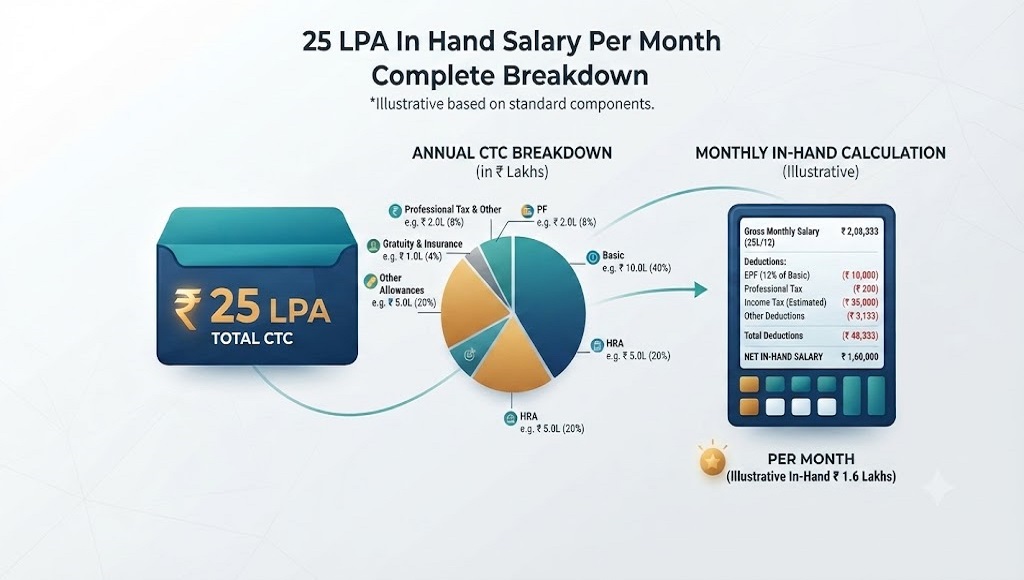
Crossing ₹25 LPA genuinely places you among India’s top earners, and for most professionals with 10-15 years of experience in senior or principal-level roles, it represents a hard-earned career milestone. However, before you start mentally spending that headline number, it genuinely helps to understand what actually lands in your account each month. This guide walks through every number involved in your real 25 LPA in hand salary, including a factor that becomes considerably more pronounced at this bracket than at ₹20 LPA.
Additionally, we’ll cover both tax regimes in detail, since careful planning genuinely matters more here than at almost any other salary level, along with the practical questions worth clarifying before accepting any offer at this bracket.
What Does 25 LPA In Hand Salary Actually Mean?
LPA stands for Lakhs Per Annum, and it represents your Cost to Company rather than your monthly take-home pay. Many professionals divide ₹25,00,000 by 12 and expect roughly ₹2,08,333 to hit their account every month. In reality, however, your actual 25 LPA in hand salary typically settles between ₹1,55,000 and ₹1,65,000, once PF, professional tax, and income tax all get factored in.
If you’d like a refresher on how CTC differs from actual salary more broadly, that guide breaks down every component clearly before we get into the specific numbers here.
₹25 LPA CTC Breakdown: Typical Salary Structure
While every employer structures CTC slightly differently, here’s a realistic breakdown you’ll commonly encounter at this level.
| Component | Approximate Annual Amount | % of CTC |
| Basic Salary | ₹10,00,000 | 40% |
| HRA | ₹5,00,000 | 20% |
| Special Allowance | ₹5,50,000 | 22% |
| Employer PF Contribution | ₹1,20,000 | 4.8% |
| Gratuity Provision | ₹48,077 | ~1.9% |
| Variable Pay / ESOPs | ₹2,50,000 | 10% |
| Other Benefits | ₹31,923 | ~1.3% |
The Fixed vs Variable or ESOP Trap at ₹25 LPA
Here’s something that genuinely becomes more pronounced at this bracket than at ₹20 LPA. Senior and leadership roles increasingly bundle a meaningful chunk of compensation into annual bonuses or Employee Stock Ownership Plans, and at ₹25 LPA, this variable component can easily represent 10-15% of your total package.
Consequently, an offer stating “₹25 LPA” might actually consist of ₹21-22 lakh in fixed cash, plus ₹3-4 lakh in bonus or ESOPs that vest gradually over several years rather than arriving monthly. Since this equity portion doesn’t contribute to your monthly cash in-hand at all, and its actual value can genuinely fluctuate with company performance, always clarify the exact fixed-to-variable split before accepting any offer at this level.
Deductions That Reduce Your ₹25 LPA to In-Hand
- Employee PF: 12% of Basic + DA, deducted monthly toward your EPF account.
- Professional Tax: A small state-specific deduction, typically capped around ₹2,500 annually.
- Income Tax (TDS): By far the largest deduction at this bracket, often working out to an effective rate of roughly 12% of your taxable income under the new regime.
25 LPA In Hand Salary: New Regime Calculation (Step-by-Step)
- Annual CTC: ₹25,00,000
- Less: Employer PF, gratuity provision, and equity component: approximately ₹4,20,000
- Gross Annual Cash Salary: approximately ₹20,80,000
- Less: Standard Deduction (₹75,000)
- Taxable Income: approximately ₹20,05,000
- Tax as per FY 2026-27 new regime slabs: approximately ₹2,64,000, plus 4% cess
- Annual Employee PF Contribution: approximately ₹1,20,000
Once you account for tax and PF, monthly in-hand under the new regime typically settles between ₹1,55,000 and ₹1,65,000, depending on your exact salary structure and posting city.
For the complete mechanics behind these slabs, our Income Tax Slabs 2026-27 guide covers both regimes with worked examples across every income bracket. You can also verify current official rates directly on the Income Tax Department’s website, since slab rates do get revised periodically.
25 LPA In Hand Salary: Old Regime Calculation
Now, suppose this same employee claims a full deduction stack — ₹1,50,000 under Section 80C, ₹75,000 under Section 80D for health insurance, ₹50,000 under NPS Section 80CCD(1B), HRA exemption based on rent paid, and ₹2,00,000 in home loan interest under Section 24(b). Here’s how the numbers shift.
- Gross Annual Cash Salary: approximately ₹20,80,000
- Less: Standard Deduction (₹50,000), HRA (approximately ₹3,00,000), 80C (₹1,50,000), 80D (₹75,000), NPS (₹50,000), and home loan interest (₹2,00,000)
- Taxable Income: approximately ₹12,55,000
- Tax as per old regime slabs: approximately ₹2,15,000, including cess
Just as we saw at ₹20 LPA, the old regime remains genuinely competitive at ₹25 LPA too, provided you’re actually claiming a full deduction stack. In this scenario, it can still save you upward of ₹50,000 to ₹60,000 annually compared to the new regime, since your marginal tax rate at this income level makes every rupee of deduction meaningfully valuable.
Old vs New Regime: Side-by-Side In-Hand Comparison
| Factor | New Regime | Old Regime (Full Deduction Stack) |
| Taxable Income | ₹20,05,000 | ₹12,55,000 |
| Approximate Annual Tax | ₹2,74,560 (incl. cess) | ₹2,23,600 (incl. cess) |
| Approximate Monthly In-Hand | ₹1,55,000 – ₹1,60,000 | ₹1,60,000 – ₹1,65,000 |
| Best Suited For | Minimal deductions, simpler compliance | Homeowners with full 80C, 80D, NPS, and HRA claims |
Does Bonus Affect Your ₹25 LPA In-Hand Salary?
Yes, genuinely so, and this is worth understanding clearly. Since bonuses typically get disbursed quarterly or annually rather than monthly, your regular monthly in-hand reflects only your fixed salary component. Consequently, if 15% of your ₹25 LPA is bonus-linked, your dependable monthly cash flow should be budgeted around the remaining 85%, not the full package, since bonus payouts can vary based on individual and company performance.
How Basic Salary Percentage Changes Your In-Hand
| Basic Salary % | Effect on PF | Effect on In-Hand |
| 40% of CTC | Moderate PF deduction | Slightly higher monthly in-hand |
| 50% of CTC | Higher PF deduction | Slightly lower monthly in-hand, stronger retirement corpus |
At ₹25 LPA, since employers almost never cap PF at the statutory minimum, your Basic percentage genuinely shapes both your monthly cash flow and your long-term retirement savings, making it worth understanding clearly before finalizing any offer negotiation.
Quick In-Hand Estimate Table by Regime
| Scenario | Approx. Monthly In-Hand |
| New Regime, Standard Structure | ₹1,55,000 – ₹1,60,000 |
| Old Regime, Full Deduction Stack | ₹1,60,000 – ₹1,65,000 |
| With Significant Bonus/ESOP Component (fixed portion only) | ₹1,30,000 – ₹1,40,000 |
₹25 LPA: City-Wise Reality Check
Your in-hand figure stays largely constant across cities, though purchasing power shifts considerably. In metro cities like Mumbai, Delhi, or Bengaluru, roughly ₹1,60,000 monthly typically covers a premium 2BHK or 3BHK, with meaningful savings potential of ₹40,000 to ₹70,000 monthly still remaining after expenses. In Tier-2 cities like Pune, Jaipur, or Coimbatore, the same amount stretches considerably further, often supporting an outright luxurious lifestyle alongside savings closer to ₹80,000 to ₹95,000 monthly, since rent and daily costs run noticeably lower.
Is ₹25 LPA a Good Salary in India?
Yes, ₹25 LPA firmly places you in the top 1% income bracket nationally, typically reflecting senior management, principal engineering, or specialized leadership roles. Most professionals reaching this level carry 10-15 years or more of experience, and this salary comfortably supports a genuinely premium lifestyle, strong savings, and solid investment capacity in virtually every Indian city, including the most expensive metros.
How to Increase Your In-Hand Salary at ₹25 LPA
- Maximize your full deduction stack under the old regime, since 80C, 80D, NPS, HRA, and home loan interest collectively offer substantial value at this income level.
- Clarify the fixed-versus-variable and ESOP split before accepting any offer, particularly if equity forms a meaningful chunk of your total package.
- Negotiate a higher fixed component if your monthly cash-flow needs are significant, since bonuses and ESOPs don’t help you cover rent or EMIs today.
- Revisit your regime choice annually, since your deductions and circumstances may shift meaningfully year to year.
Since gratuity also forms a genuine part of your CTC at this level, it’s worth understanding exactly how that component works too. Our Gratuity Rules 2026 guide explains current eligibility and calculation rules clearly.
Common Mistakes Professionals Make at ₹25 LPA
- Assuming the full CTC figure represents guaranteed monthly cash, without checking how much is tied to bonus or ESOPs.
- Sticking with the new regime by default, even when a full deduction stack would clearly favor the old regime at this bracket.
- Underestimating how significantly income tax eats into take-home pay at this level, compared to lower salary brackets.
- Not negotiating the fixed-versus-variable split, even when it genuinely affects monthly financial planning.
If you’re weighing this offer against a slightly lower CTC elsewhere, it also helps to compare against our ₹20 LPA and ₹15 LPA in-hand salary guides to see exactly how the regime advantage and deduction value shift across brackets.
Frequently Asked Questions
Is 25 LPA a good salary in India?
Yes, it places you in the top 1% income bracket nationally, typically reflecting senior management or principal-level roles with 10-15 years or more of experience.
Which regime is better for 25 LPA — old or new?
For most people at this bracket, the old regime remains slightly ahead, provided you claim a full deduction stack including 80C, 80D, NPS, HRA, and home loan interest, potentially saving ₹50,000–₹60,000 annually.
How much tax do I pay on 25 LPA salary?
Under the new regime, expect roughly ₹2,70,000–₹2,80,000 annually. Under the old regime with a full deduction stack, this can drop to approximately ₹2,20,000–₹2,30,000.
Does 25 LPA include bonus or ESOPs?
Often, yes, particularly for senior roles. It's essential to clarify how much of your ₹25 LPA is fixed cash versus bonus or equity, since these components don't contribute to your monthly in-hand salary the way fixed pay does.
Why is my in-hand lower than ₹25L ÷ 12?
Because that simple division ignores employer PF contributions, gratuity provisioning, equity components, employee PF deductions, professional tax, and income tax, all of which reduce your CTC before it becomes actual take-home pay.
Can bonuses change my monthly in-hand salary?
Yes, since bonuses typically get disbursed quarterly or annually rather than monthly, your regular monthly in-hand reflects only your fixed salary component, not the bonus-linked portion.
Is PF calculated on the full basic salary at 25 LPA?
This depends on your employer's policy. Most companies at this income level apply the full 12% to your actual Basic salary rather than capping it at the statutory minimum.
How much professional tax is deducted at 25 LPA?
Professional tax is state-specific and generally capped around ₹2,500 annually, regardless of how high your salary is, making it a relatively minor deduction at this level.
Conclusion
Your ₹25 LPA in hand salary genuinely depends on a careful mix of factors at this bracket, from the fixed-versus-variable split in your offer to your regime choice and deduction strategy. Consequently, careful tax planning matters more here than at almost any other salary level, since a full deduction stack under the old regime continues to hold a genuine, though narrowing, advantage. Before accepting your next offer or finalizing your regime choice for the year, run both scenarios against your actual numbers, clarify exactly what portion of your package is guaranteed cash, and you’ll walk into your financial planning with a genuinely accurate picture of what lands in your account every month.
For more salary breakdowns, tax guides, and career resources, visit Career Salary Hub.


Post Comment