7 LPA In Hand Salary Per Month: Complete Breakdown (2026)
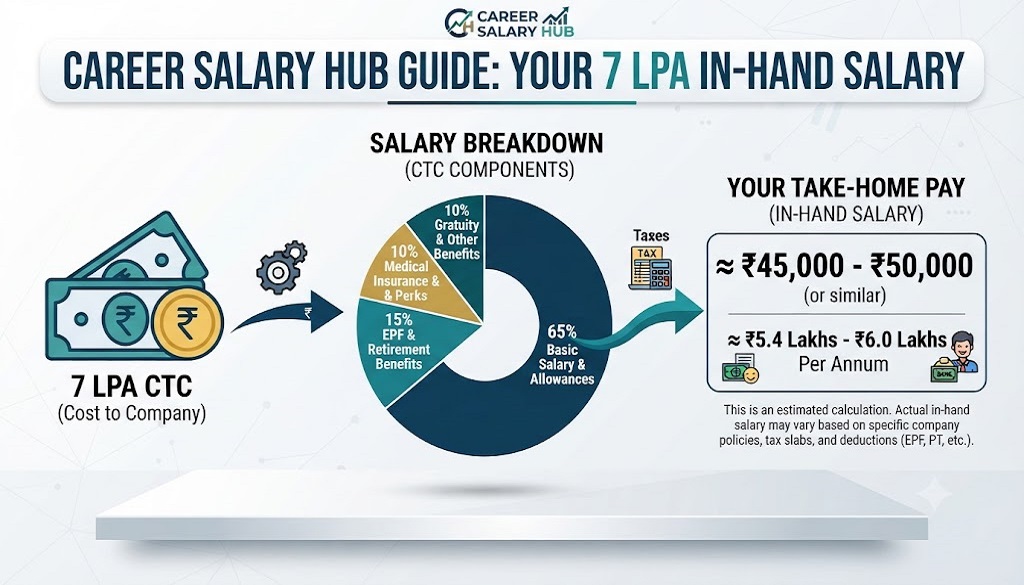
If you have just received a job offer with a 7 LPA package, or you are comparing offers before accepting one, the first question you probably have is simple: how much money will actually land in your bank account every month? A 7 LPA in hand salary is one of the most searched salary queries in India, and for good reason. The Cost to Company figure on your offer letter rarely matches what you actually take home.
This guide breaks down exactly what a 7 LPA in hand salary per month looks like in 2026, including a genuinely welcome update: under the new tax regime, most people at this income level pay zero income tax. We will walk through the full CTC structure, the deductions that apply, both tax regimes side by side, and what this salary actually means for your lifestyle depending on where you live.
What Does 7 LPA In Hand Salary Actually Mean?
LPA stands for Lakhs Per Annum, and a 7 LPA offer means your employer has agreed to spend ₹7,00,000 on you annually. However, that figure is your Cost to Company, or CTC, not your take-home pay. Many freshers make the mistake of dividing ₹7,00,000 by 12 and expecting roughly ₹58,333 every month.
In reality, your 7 LPA in hand salary per month typically falls between ₹51,000 and ₹55,000, once employee provident fund contributions, professional tax, and any applicable income tax are factored in. This gap exists because CTC includes several components that never actually reach your bank account, such as the employer’s PF contribution and gratuity provisioning.
If you want a deeper primer on how CTC differs from your real salary, our guide on what is CTC in salary walks through every component in detail before we get into the specific numbers for this bracket.
₹7 LPA CTC Breakdown: Typical Salary Structure
While every employer structures CTC slightly differently, here is a realistic breakdown you will commonly encounter at the 7 LPA level.
| Component | Approximate Annual Amount | % of CTC |
| Basic Salary | ₹2,80,000 | 40% |
| HRA | ₹1,40,000 | 20% |
| Special Allowance | ₹1,68,000 | 24% |
| Employer PF Contribution | ₹33,600 | 4.8% |
| Gratuity Provision | ₹13,462 | ~1.9% |
| Performance Bonus | ₹50,000 | ~7.1% |
| Other Benefits | ₹14,938 | ~2.1% |
Deductions That Reduce Your ₹7 LPA to In-Hand
A handful of standard deductions stand between your CTC and your actual bank credit every month. Understanding each one helps you see exactly where the difference comes from.
- Employee Provident Fund (EPF): 12% of your Basic salary, deducted every month and deposited into your EPF account. You can check your own EPF balance and rules directly on the Employees’ Provident Fund Organisation (EPFO) portal.
- Professional Tax: A small, state-specific deduction, generally capped around ₹2,500 annually, or roughly ₹200 a month.
- Income Tax (TDS): At ₹7 LPA, this is often zero under the new regime, which we cover in detail below.
- Other Deductions: Group health insurance premiums or optional benefits, depending on your employer’s policy.
The Zero-Tax Advantage at ₹7 LPA (New Regime, FY 2026-27)
Here is genuinely good news if you are earning around 7 LPA. Under the new tax regime for FY 2026-27, resident individuals with taxable income up to ₹12 lakh pay zero income tax, thanks to a rebate of up to ₹60,000 under the tax law. Salaried employees also get a standard deduction of ₹75,000, which pushes the effectively tax-free threshold even higher.
Since your 7 LPA CTC translates into a taxable income well below the ₹12 lakh mark once employer contributions and the standard deduction are subtracted, most employees at this bracket end up owing no income tax at all under the new regime. This is a meaningful shift compared to a few years ago, when even mid-range salaries attracted noticeable TDS.
Naturally, tax rules are revised periodically, so it is worth confirming the current slabs on the official Income Tax Department website before finalising your own calculations. For a complete regime-by-regime comparison across every income bracket, our Income Tax Slabs 2026-27 guide covers the mechanics in more depth.
7 LPA In Hand Salary: Monthly Calculation (New Regime, Step-by-Step)
- Annual CTC: ₹7,00,000
- Less: Employer PF, gratuity provision, and bonus component: approximately ₹97,000
- Gross Annual Cash Salary: approximately ₹6,03,000
- Less: Standard Deduction (₹75,000)
- Taxable Income: approximately ₹5,28,000
- Tax as per FY 2026-27 new regime slabs, after Section 87A rebate: ₹0
- Annual Employee PF Contribution: approximately ₹33,600
Once you subtract your own PF contribution from the gross cash salary, your 7 LPA in hand salary per month works out to roughly ₹51,000 to ₹55,000, depending on your exact structure, bonus payout schedule, and posting city.
7 LPA In Hand Salary: Old Regime Calculation
Under the old regime, you lose the higher rebate threshold but gain access to deductions such as Section 80C, HRA exemption, and Section 80D. At this income level, though, most early-career professionals have not yet built up a large deduction stack, so the comparison looks different than it does at higher salaries.
- Gross Annual Cash Salary: approximately ₹6,03,000
- Less: Standard Deduction (₹50,000)
- Taxable Income (assuming minimal additional deductions): approximately ₹5,53,000
- Tax as per old regime slabs: approximately ₹34,000, including cess
Consequently, unless you are already claiming a full 80C investment, HRA exemption, and other deductions, the new regime almost always works out better at the 7 LPA level, since it results in zero tax rather than a real annual liability of around ₹34,000.
Old vs New Regime: Side-by-Side In-Hand Comparison
| Factor | New Regime | Old Regime (Minimal Deductions) |
| Taxable Income | ₹5,28,000 | ₹5,53,000 |
| Approximate Annual Tax | ₹0 | ₹34,000 (incl. cess) |
| Approximate Monthly In-Hand | ₹51,000 – ₹55,000 | ₹48,000 – ₹50,000 |
| Best Suited For | Most 7 LPA earners, especially freshers | Only if claiming a full deduction stack |
Does HRA Affect Your 7 LPA In-Hand Salary?
Yes, but its impact depends on which regime you choose. Under the old regime, HRA exemption can meaningfully lower your taxable income if you pay rent and can furnish proof. Under the new regime, however, HRA exemption is not available, which is one reason the new regime keeps things simpler for most people in this bracket.
If your taxable income is already at or near zero tax under the new regime, HRA exemption offers little additional benefit, since you are not paying tax to begin with.
₹7 LPA In-Hand Salary: City-Wise Reality Check
Your in-hand figure stays largely the same regardless of city, but what that money can actually buy shifts considerably depending on where you are posted.
| City Tier | Typical Monthly In-Hand | What It Comfortably Covers |
| Metro (Mumbai, Delhi, Bengaluru) | ₹51,000 – ₹55,000 | Shared flat or PG, moderate savings after expenses |
| Tier-2 (Pune, Jaipur, Coimbatore) | ₹51,000 – ₹55,000 | 1BHK independently, stronger savings potential |
Industries That Typically Offer 7 LPA in India
A 7 LPA package appears across a wide range of sectors, though it means different things depending on the industry and role level.
- IT and software services, particularly for candidates with one to two years of experience
- Banking, insurance, and financial services operations roles
- Sales and business development positions with a fixed-plus-incentive structure
- Core engineering and manufacturing roles for early-career professionals
Is 7 LPA a Good Salary in India?
Yes, particularly for freshers and early-career professionals. A 7 LPA in hand salary places you comfortably above the national average income and offers genuine financial independence in most Indian cities, especially outside the most expensive metros.
For professionals with three to six years of experience, 7 LPA is more of a baseline than a milestone, since many mid-level roles command higher packages. For senior professionals with seven or more years of experience, a 7 LPA offer would typically sit below market rate, though this varies by industry and specialisation.
Career Growth From a 7 LPA Starting Point
With consistent annual increments of around 10 to 20 percent, a 7 LPA package can realistically grow to somewhere between 12 LPA and 15 LPA within five years, and considerably higher over seven to ten years, depending on your role, industry, and how proactively you negotiate at each appraisal cycle.
Savings Potential on ₹7 LPA In-Hand Salary
On a monthly in-hand of roughly ₹52,000, a common budgeting approach allocates around 30 to 35 percent toward rent and utilities, 30 to 35 percent toward daily living expenses, and the remaining 30 to 40 percent toward savings and investments, assuming you are living independently in a shared or modest arrangement.
Popular starting instruments at this income level include a Systematic Investment Plan (SIP) in mutual funds, the Public Provident Fund (PPF), and the National Pension System (NPS), all of which allow you to begin building a long-term corpus even on a modest monthly surplus.
How to Increase Your In-Hand Salary at ₹7 LPA
- Review your tax regime choice every financial year, since your circumstances and deductions may change
- Negotiate a higher fixed component if your monthly cash-flow needs are significant
- Claim eligible exemptions accurately if you opt for the old regime and have supporting proof
- Upskill through relevant certifications, since this often accelerates your next salary jump more than fine-tuning deductions ever will
Common Mistakes Professionals Make at ₹7 LPA
- Assuming the full CTC figure represents guaranteed monthly cash, without accounting for PF and gratuity provisioning
- Sticking with the old regime out of habit, even when the new regime clearly results in lower or zero tax at this income level
- Not checking the fixed-versus-bonus split before accepting an offer, since bonus components are not paid monthly
- Overlooking state-specific professional tax, which, while small, still reduces your final in-hand amount
Quick In-Hand Estimate Table
| Scenario | Approx. Monthly In-Hand |
| New Regime, Standard Structure | ₹51,000 – ₹55,000 |
| Old Regime, Minimal Deductions | ₹48,000 – ₹50,000 |
| With Significant Bonus Component (fixed portion only) | ₹45,000 – ₹48,000 |
Compare With Other Salary Brackets
If you are weighing this offer against a different package, it helps to see how the numbers shift just above and below this bracket.
Our 6 LPA in hand salary guide and 8 LPA in hand salary guide break down the same calculations one step below and one step above 7 LPA, so you can see exactly how much of a difference each bracket makes to your monthly take-home.
It is also worth understanding how gratuity fits into your overall CTC once you cross a few years at the same employer. Our Gratuity Rules 2026 guide explains eligibility and calculation clearly.
Frequently Asked Questions (FAQ): 7 LPA In Hand Salary
Is income tax applicable on 7 LPA?
For most people, no. Under the new tax regime for FY 2026-27, taxable income up to ₹12 lakh is effectively tax-free due to the Section 87A rebate and standard deduction, and a 7 LPA CTC comfortably falls within that limit.
Is 7 LPA a good salary for a fresher?
Yes. For freshers and candidates with zero to two years of experience, a 7 LPA in hand salary is considered a strong starting package that offers genuine financial independence in most Indian cities.
How much is 7 lakh in CTC compared to in-hand salary?
A 7 lakh CTC translates to roughly ₹51,000 to ₹55,000 in-hand per month, since employer PF contribution, gratuity provisioning, and employee deductions reduce the figure before it reaches your account.
What is the difference between CTC and in-hand salary?
CTC, or Cost to Company, is the total amount your employer spends on you annually, including components you never receive as direct cash, such as employer PF and gratuity. In-hand salary is the actual amount credited to your bank account each month after all deductions.
Does the new tax regime affect my 7 LPA in-hand salary?
Yes, significantly. The new regime's higher rebate threshold means most 7 LPA earners pay zero income tax, which directly increases monthly in-hand pay compared to the old regime for anyone without a large deduction stack.
How much is 6 LPA in-hand salary, for comparison?
A 6 LPA package typically results in a slightly lower monthly in-hand figure. See our full 6 LPA in-hand salary breakdown for the exact numbers.
Can I negotiate my in-hand salary within a 7 LPA CTC?
Yes, to some extent. While the total CTC may be fixed, you can often negotiate the split between fixed basic pay, allowances, and bonus, which affects how much lands in your account monthly versus how much is deferred.
What percentage of CTC is in-hand salary in India?
At the 7 LPA level, in-hand salary typically works out to roughly 87 to 90 percent of CTC under the new regime, since zero tax liability means deductions are largely limited to PF and professional tax.
What deductions are made from CTC to arrive at in-hand salary?
The main deductions are employer PF contribution, gratuity provisioning, employee PF contribution, professional tax, and income tax, though the last is often nil at this income level under the new regime.
Conclusion
Your 7 LPA in hand salary genuinely depends on your CTC structure, your tax regime choice, and how much of your package is tied to fixed pay versus bonus. The good news is that at this bracket, the new tax regime works strongly in your favour, and most earners land between ₹51,000 and ₹55,000 per month with little to no income tax.
Before accepting your next offer, run the numbers against your own salary structure, clarify the fixed-versus-variable split, and compare your regime choice each financial year. For more salary breakdowns, tax guides, and career resources, visit Career Salary Hub.




Post Comment