DA Hike September 2026: Latest News, Expected Rate, Calculator & Full Guide
If you’re a central government employee or pensioner, you’ve probably heard the buzz already. The DA hike September 2026 conversation is everywhere right now, from office WhatsApp groups to pension forums.
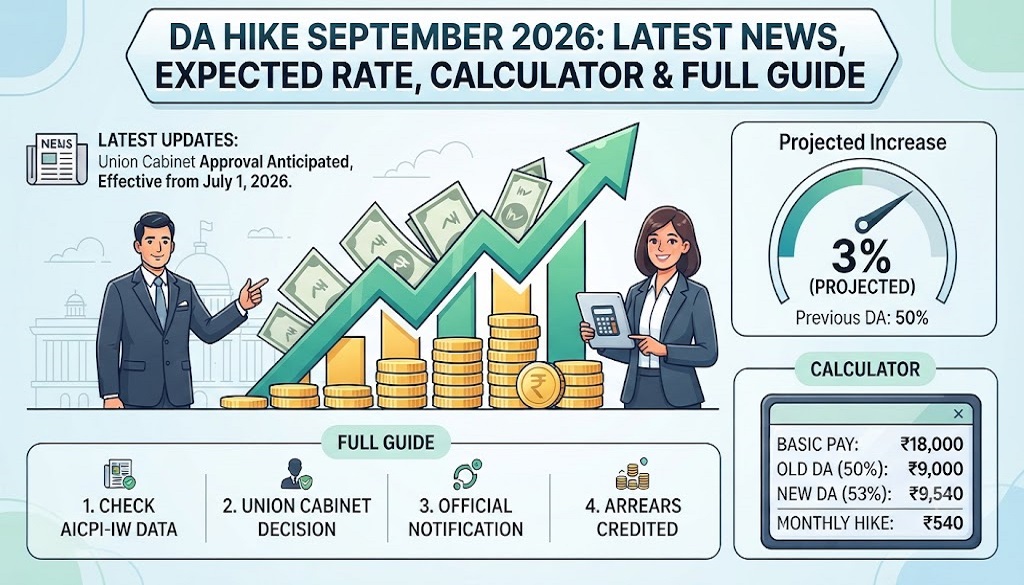
The current Dearness Allowance stands at 60%, and fresh inflation data suggests it’s about to climb to 63%. That’s not pocket change for the roughly five million central employees and 6.5 million pensioners who depend on this adjustment twice a year.
This guide explains where things stand, how officials calculate the number, when you can realistically expect the official order, and how the change could affect your take-home pay, based on the latest AICPI-IW data available as of August 2026.
What Is Dearness Allowance (DA)? A Quick Primer for Beginners
Dearness Allowance is a cost-of-living adjustment paid to government employees and pensioners in India. Because inflation quietly erodes purchasing power every year, the government revises this allowance twice annually to help salaries keep pace with rising prices.
DA is calculated as a percentage of an employee’s basic pay. For pensioners, the equivalent adjustment is called Dearness Relief, or DR. Both move in lockstep, since they’re calculated using the same formula.
Who actually benefits from this?
- Central government employees under the 7th Pay Commission
- Central government pensioners and family pensioners
- Many state government employees, though rates and timing can differ by state
- Employees of certain public sector banks and institutions that follow similar DA structures
If you’ve been tracking salary trends on Career Salary Hub, you’ll know that DA is one of the biggest year-on-year swing factors in a government employee’s actual take-home pay, sometimes even more impactful than an annual increment.
DA Hike News Today: Latest Update
The Labour Bureau, which operates under the Ministry of Labour and Employment, released the All India Consumer Price Index for Industrial Workers (AICPI-IW) data for June 2026. The index rose to 151.9, up 1.1 points from the previous month.
That release matters a lot, because June is the final month needed to compute the DA revision for the July–December 2026 period. With the complete dataset now available, the calculation has settled at approximately 63.77%, which under standard rounding rules works out to a 63% DA rate, a three-point increase from the current 60%.
This isn’t the first signal either. Back in May 2026, when partial data was available, analysts were already projecting a similar outcome. The June figures simply confirmed the trend rather than changing it.
Here’s an important distinction, though: the calculation and the official government order are two separate things. The 63% figure is what the formula produces. It still needs Cabinet approval before it becomes official policy, and that approval typically arrives a few weeks or months after the underlying data is finalized.
How Is DA Calculated? The AICPI-IW Formula Explained
The Official 7th CPC Formula
The government uses this formula for central government employees under the 7th Pay Commission:
DA% = [(Average AICPI-IW for the last 12 months × 2.88) − 261.4] ÷ 261.4 × 100
A couple of things worth unpacking here:
- The “average AICPI-IW” is calculated over a rolling 12-month window, not a single month’s figure.
- The 2.88 linking factor converts the 2016-base index into the older 2001-base series that the 7th Pay Commission structure still relies on.
- The final percentage is always rounded down to the nearest whole number, never rounded up. This is a detail many people miss, and it’s why a calculated 63.77% becomes an official 63%, not 64%. The Department of Expenditure, Ministry of Finance, publishes official orders confirming each revision once approved.
Worked Example Using Current AICPI Data
For the July 2026 revision, the relevant window is July 2025 to June 2026. Based on published Labour Bureau data, the 12-month average AICPI-IW works out to roughly 149.5 to 150.8, depending on which month’s provisional figures you use.
Plugging that average into the formula produces a result in the 63% to 64% range. Because of the rounding-down rule, 63% is the figure most analysts are settling on.
Consumer Price Index for Industrial Workers (CPI-IW): June 2026 Data
For readers who like to verify things themselves rather than take numbers at face value, here’s a simplified look at how the index moved through the first half of 2026.
| Month (2026) | AICPI-IW Index | Change from Previous Month |
|---|---|---|
| January | 148.6 | — |
| February | 148.5 | -0.1 |
| March | 149.1 | +0.6 |
| April | 149.9 | +0.8 |
| May | 150.8 | +0.9 |
| June | 151.9 | +1.1 |
You can see a steady upward trend through the second quarter, which is consistent with the DA hike expectation. If you want to cross-check the raw index data yourself, the Labour Bureau publishes it monthly on its official website.
Expected DA Hike Percentage: How Much Will It Increase?
Most projections converge on a 3-percentage-point increase, though a small number of estimates suggest it could stretch to 4%. Here’s a simple before-and-after comparison.
| Detail | Current (Jan–June 2026) | Expected (July–Dec 2026) |
|---|---|---|
| DA Rate | 60% | 63% |
| Increase | — | 3 percentage points |
| Applicable From | January 1, 2026 | July 1, 2026 |
| Beneficiaries | ~5 million employees, ~6.5 million pensioners | Same |
To put this in perspective: an employee with a basic pay of Rs 18,000 (Level-1) would see their DA component rise by roughly Rs 540 per month under a 3% hike. Someone with a higher basic pay of Rs 56,900 would see a monthly increase of over Rs 1,700, purely from the DA revision. If you want to compare this against different pay levels, check our detailed LPA salary breakdowns for a fuller picture.
That’s a meaningful jump, especially once you factor in six months of retroactive arrears.
What Happens Before Employees Get the Revised DA?
This administrative chain is exactly where the “when will it be announced” confusion comes from:
- The Labour Bureau publishes monthly AICPI-IW data.
- Once the full 12-month dataset is available, the Department of Expenditure calculates the DA percentage.
- A formal proposal goes to the Cabinet for consideration.
- The Union Cabinet approves the revision.
- The Finance Ministry issues an official memorandum notifying the new rate.
- Payroll departments implement the change, along with pending arrears.
Each step takes time, which is why there’s usually a gap of weeks to months between when the formula “confirms” a number and when it’s actually paid out.
DA Hike Cabinet Approval Date: When Will It Be Officially Announced?
Historically, the July–December DA revision has been announced anywhere between September and November. Looking at recent years:
- In 2024, the announcement came in mid-October, close to Diwali.
- In past cycles, some approvals have landed in September, just ahead of the festive season.
- The pattern strongly correlates with Diwali timing, since the government has often preferred to announce salary-related good news before the festival.
Diwali in 2026 falls on November 8. Based on that pattern, a September 2026 announcement is possible but not guaranteed. Many observers believe October remains just as likely, with November being the outer boundary based on precedent.
Important note: Regardless of when the formal order is issued, the revised DA rate is always applied retroactively from July 1, 2026. So even if the announcement slips into October or November, you won’t lose out on any money, you’ll simply receive it as arrears alongside your regular salary.
DA Arrears Calculation 2026: How Much Will You Get?
Arrears arise when the new DA rate takes effect on July 1 but payroll systems implement the change later. If the government issues the order in September, employees could receive two to three months of arrears as a lump sum, followed by the revised DA rate in future paychecks. If the government delays the order until October or November, employees could receive an additional one or two months of arrears.
Simple Example
Suppose your basic pay is Rs 35,400 and DA rises by 3%. Your monthly DA increase is Rs 1,062. If the order comes in October, covering July through September as arrears, you’d receive roughly Rs 3,186 as a one-time payment, plus the higher monthly rate going forward. Your actual figure will depend on your specific pay level.
Impact on Pensioners: Dearness Relief (DR) Hike
Dearness Relief moves in exact parallel with DA, using the identical AICPI-IW formula and effective dates. So if DA rises to 63% from July 2026, DR for pensioners rises to the same 63% on the same date. This covers regular pensioners, family pensioners, and those under bank pension schemes, where the Indian Banks’ Association issues separate DR orders that sometimes lag slightly behind the central order.
Will HRA Also Change After This DA Hike?
House Rent Allowance under the 7th Pay Commission changes automatically only when DA crosses specific thresholds, typically 25% and 50%. Since DA has already crossed the 50% mark, this particular 3-point rise to 63% is unlikely to trigger any additional HRA revision on its own.
State-Wise DA Hike Updates
Several states run their own parallel DA systems, and the rates don’t always match the central figure.
- Odisha: Periodically revises DA for state employees, often shortly after the central announcement, though the percentage and timing can differ.
- Tamil Nadu: Has historically adjusted its own DA rate independently, sometimes ahead of or behind the central schedule.
- Kerala, Haryana, and Jammu & Kashmir: All have issued their own DA and DR revisions in recent cycles, generally following the central pattern with some lag.
If you work for a state government, check your specific finance department’s notifications separately rather than assuming the central rate applies to you.
DA Hike vs 8th Pay Commission: What Changes Next?
The 8th Central Pay Commission has already been constituted, and its terms of reference are in progress. Commission members have been conducting state visits, including sessions in Jaipur and planned visits to Bengaluru, to gather input from employee associations and pensioner groups. Demands submitted so far include a minimum pension of Rs 45,000 per month and a 50% family pension benchmark from groups like Bharat Pensioners’ Samaj.
7th CPC vs 8th CPC: What’s Different
Until the government formally implements the 8th Pay Commission’s recommendations, employees will continue receiving DA under the existing 7th CPC framework. Once the government introduces the new pay matrix, DA typically resets to zero because the new basic pay already absorbs the accumulated dearness allowance. Therefore, the 63% figure we’re discussing now won’t simply carry forward — the new pay structure will absorb it into the revised basic pay.
Common Mistakes to Avoid When Estimating Your DA Hike
- Treating provisional AICPI data as final. Early-month estimates can shift slightly once revised figures are published.
- Assuming the hike is payable immediately. The calculated percentage and the Cabinet-approved, notified percentage aren’t the same until an official order exists.
- Mixing up central and state DA rates. They frequently differ, sometimes significantly.
- Forgetting the rounding-down rule. A calculated 63.77% doesn’t round up to 64%, it rounds down to 63%.
- Ignoring the arrears timeline. No one “misses out” on the months between July and the announcement date — that period is simply paid as a lump-sum arrear.
Best Practices for Tracking Your DA Hike
- Check the Labour Bureau’s monthly AICPI-IW release rather than relying on secondhand summaries
- Bookmark a reliable salary and pay commission tracker like Career Salary Hub
- Use a DA calculator to estimate your personal arrears once the percentage is confirmed
- Cross-verify news with official government press releases before making financial decisions
- Watch both the central announcement and your state’s notification if applicable
Why This Matters Beyond Individual Salaries
With over 11 million employees and pensioners receiving higher payouts, there’s typically a modest boost to consumer spending the following quarter, with sectors like retail and banking often seeing a small demand uptick. At the same time, the added fiscal outlay pressures government expenditure planning, which is one reason the Finance Ministry tends to move deliberately rather than rushing the announcement.
Frequently Asked Questions
What will be the new DA percentage from July 2026?
Based on finalized AICPI-IW data through June 2026, the DA rate is expected to rise from 60% to 63%.
How is DA calculated for 7th Pay Commission employees?
Using the formula: [(Average AICPI-IW for 12 months × 2.88) − 261.4] ÷ 261.4 × 100, rounded down to the nearest whole number.
When will DA arrears for July 2026 be paid?
Once the official order is issued, covering the gap between July 1 and the notification date, typically credited as a lump sum with the next salary or pension.
What is the current DA rate for central government employees in 2026?
As of January 2026, the DA rate stands at 60%, up from 58% previously.
What is AICPI-IW and where can I find the latest data?
The All India Consumer Price Index for Industrial Workers, published monthly by the Labour Bureau under the Ministry of Labour and Employment.
Do pensioners also get a DA hike?
Yes — pensioners receive Dearness Relief (DR), calculated using the same formula and effective date as DA.
Is there a DA hike for Odisha government employees in 2026?
Odisha periodically issues its own DA revisions, which may differ in percentage and timing from the central rate. Check the state finance department's notifications for exact figures.
Is there a DA hike for Tamil Nadu government employees in 2026?
Tamil Nadu maintains its own DA revision schedule, which doesn't always align with the central timeline.
Will HRA increase along with this DA hike?
Not automatically — HRA slabs change only when DA crosses thresholds like 25% or 50%, and DA has already crossed 50%.
Conclusion
The DA hike for July–December 2026 is essentially confirmed at the calculation level, with the rate set to rise from 60% to 63%. What remains is the formal Cabinet approval, which history suggests could land anywhere between September and November 2026.
Whenever it arrives, the increase applies retroactively from July 1, so no one loses out regardless of the announcement date. The smartest move is to track official Labour Bureau data releases rather than unverified rumors.
For ongoing updates on pay commission news and government employee benefits, visit Career Salary Hub.
Sources: Data referenced from the Labour Bureau (Ministry of Labour and Employment), Government of India, and the Department of Expenditure. For background on the concept of Dearness Allowance, see Wikipedia’s overview. Official AICPI-IW releases can be verified at labourbureau.gov.in.

Post Comment