Diwali Bonus 2026: Eligibility, Amount & Salary Advance Rules Explained
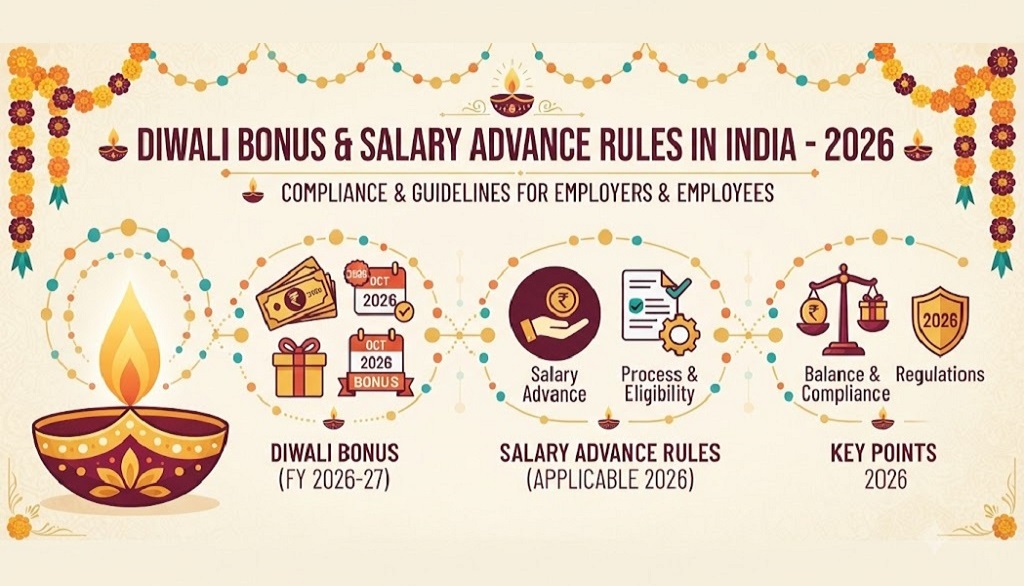
Diwali 2026 falls on Sunday, November 8, and the five-day celebration runs from November 6 to November 10. As the festival approaches, two questions start circulating in almost every office WhatsApp group: “Will we get a Diwali bonus this year?” and “Can I ask HR for a salary advance before the festival?”
These two payments feel similar because they both show up around the same time of year. However, they work in completely different ways, follow different rules, and carry different obligations for your employer. This guide breaks down exactly what Diwali bonus 2026 means for you, how it differs from statutory bonus, and what the actual rules around salary advance in India look like.
If you’re also curious about the legal, mandatory bonus every eligible employee is entitled to, our detailed guide on statutory bonus in India covers the Payment of Bonus Act separately, since that’s a different entitlement altogether.
What Is a Diwali Bonus? (Discretionary Bonus Explained)
A Diwali bonus is, at its core, a goodwill gesture. Unlike statutory bonus, which is governed by law, a Diwali bonus is entirely at your employer’s discretion. No act or code forces a company to pay it, and no employee can take legal action simply because their employer skipped it.
That said, most Indian companies still choose to give some form of festive payout, largely because it boosts morale and reflects well on the organisation’s culture. The amount, timing, and even the format vary enormously from one company to the next.
Forms Diwali Bonus Comes In
Depending on the company, a Diwali bonus can take several shapes:
- Cash bonus – a fixed amount or a percentage of monthly salary credited directly to your account
- Gift vouchers – for retail chains, e-commerce platforms, or gold purchases
- Ex-gratia payment – a one-time discretionary payout, often used interchangeably with “Diwali bonus”
- 13th-month pay – common in MNCs, where an extra month’s salary is paid around the festive season
- Physical gifts – sweets, hampers, or household items, especially in smaller firms and manufacturing units
How Diwali Bonus Adjusts Against Statutory Bonus
Here’s something many employees don’t realise. If your employer pays you a Diwali bonus that is equal to or greater than your statutory bonus entitlement, and it’s paid within the same accounting year, it can be adjusted against the statutory bonus owed to you. In other words, your employer doesn’t necessarily have to pay both amounts separately.
However, if the Diwali bonus you received is smaller than your statutory entitlement, your employer still owes you the difference. Our statutory bonus guide walks through the 8.33% to 20% calculation formula in detail if you want to check your own numbers.
Diwali Bonus 2026: Eligibility and Latest Updates
Who Will Get the Diwali Bonus in 2026?
Because it’s discretionary, eligibility for a Diwali bonus depends entirely on individual company policy. Most organisations that do offer one extend it to all confirmed employees, though some restrict it further based on tenure, department, or performance ratings. Freshers on probation, contract staff, and interns are often excluded, so it’s worth checking your company’s HR policy directly rather than assuming.
Government Employees: Diwali Bonus Update
Central government employees typically receive their festive bonus through two separate schemes: a Productivity Linked Bonus (PLB) for select departments like postal services, and a Non-Productivity Linked Bonus (Ad-hoc Bonus) for Group C and non-gazetted Group B employees. In recent years, this ad-hoc bonus has been calculated on a capped monthly salary of ₹7,000, using the formula: (Rs 7,000 × number of bonus days) ÷ 30.4. For a 30-day bonus, that works out to roughly ₹6,908.
To qualify, employees generally need to have completed at least six months of continuous service and been in service as of the relevant cut-off date, typically March 31 of that financial year. State government bonuses, such as festive gifts announced by individual state governments for categories like anganwadi workers or municipal staff, are separate schemes with their own amounts and eligibility, so always check your specific state government’s official notification rather than relying on figures from another state or year.
When Will Diwali Bonus 2026 Be Credited?
Most private employers aim to disburse Diwali bonuses just before the festival, so expect payouts anywhere from late October through the first week of November 2026. This is different from the statutory bonus deadline, which legally extends up to eight months after the financial year ends, meaning employers technically have until 30 November 2026 to pay out FY 2025-26 statutory bonus dues.
Industry-Wise Diwali Bonus Trends
Bonus culture varies quite a bit depending on the sector you work in, and it’s worth understanding these patterns before you set expectations.
IT and tech companies generally tie festive bonuses to individual and company performance, so the amount can swing significantly between a good year and a lean one. Many tech firms also prefer non-cash formats like vouchers or points-based reward systems.
Banking and finance sector employees, especially in public sector banks, often see bonus structures linked to union-negotiated settlements, which tend to be more predictable year over year compared to private-sector performance bonuses.
Manufacturing and PSU organisations frequently combine statutory bonus with an additional festive ex-gratia payment, since many factory workers fall under the wage ceiling that makes statutory bonus mandatory in the first place.
Startups versus MNCs show the widest gap. Startups with tighter cash flow often skip cash bonuses altogether in favour of smaller gestures, while established MNCs are more likely to maintain consistent festive payout policies as part of their retention strategy.
If you’re trying to benchmark your own expected payout against your CTC structure, our CTC vs salary guide explains how bonus components typically fit into your overall compensation package.
Salary Advance Rules in India: What You Need to Know
Once the festive bonus conversation settles, the next common question is whether you can request an advance on your own salary to cover Diwali expenses. This is a completely different arrangement from a bonus, and it’s worth understanding the distinction clearly.
What Is a Salary Advance?
A salary advance is essentially an early withdrawal of money you’ve already earned or will soon earn. Unlike a bonus, which is extra money, an advance is simply your own upcoming salary paid to you sooner than your usual payday. It also differs from a personal loan, since a salary advance typically doesn’t carry interest and gets repaid directly through payroll deductions rather than a separate EMI process.
Is an Employer Legally Bound to Give a Salary Advance?
No specific Indian law compels a private employer to offer salary advances. There’s no dedicated “Salary Advance Act.” Instead, this facility exists purely because individual companies choose to build it into their HR policy, often as an employee-welfare measure.
That said, the broader framework of the Payment of Wages Act, 1936 governs how and when wages must be paid, and the Shops and Establishment Act (which varies by state) sets general employment conditions. Neither law mandates advances, but they do provide the backdrop against which most company advance policies are drafted.
Typical Eligibility Criteria
While every company sets its own rules, most salary advance policies in India share a few common conditions:
- Minimum tenure with the company, often six months to one year
- Confirmed employment status (probationary employees are frequently excluded)
- Clean repayment history if the employee has taken an advance before
- A genuine, documented reason such as a medical emergency, family event, or urgent expense
- A cap on how many advances can be requested within a financial year, typically one or two
Repayment Structure
Repayment usually happens in one of two ways. Some companies deduct the full advance from your very next salary, while others spread it across two to three months as smaller instalments. Either way, this deduction shows up clearly on your payslip, and it’s worth checking your salary slip format to understand exactly how such deductions get reflected.
Because it’s your own earned money paid early rather than borrowed money, salary advances generally don’t attract interest. However, some companies do charge a nominal processing fee, so it’s worth checking your specific company policy before applying.
Salary Advance vs Bonus vs Loan
| Feature | Salary Advance | Diwali Bonus | Personal Loan |
| Nature | Early payment of your own salary | Extra, discretionary payment | Borrowed money from a third party |
| Legally mandatory? | No | No | Not applicable |
| Interest charged? | Usually none | Not applicable | Yes |
| Repayment | Deducted from future salary | Not repaid | EMI over agreed tenure |
| Approval needed? | Yes, from employer | Not applicable | Yes, from lender |
How to Apply for a Salary Advance
Step-by-Step Application Process
- Check your company’s HR policy to confirm you meet the eligibility criteria before applying.
- Submit a formal written request, either through an HR portal or a physical application, clearly stating the reason and amount needed.
- Get manager or department head approval, which most companies require alongside HR sign-off.
- Wait for HR/finance verification, where they’ll confirm your eligible amount based on your current earned salary.
- Receive disbursement, usually within a few working days once approved.
- Track the deduction on your subsequent payslip to confirm it matches the agreed repayment schedule.
Documents Typically Needed
- Filled advance salary application form
- Proof or explanation for the request, especially for medical or emergency cases
- Employee ID and bank account details for disbursement
- Manager’s approval or digital sign-off, depending on the company’s workflow
How Much Advance Can You Get?
Most Indian companies cap salary advances at one to three months of net salary, though this varies significantly by organisation size and policy. Smaller companies with tighter cash flow may limit advances to a single month’s salary, while larger, well-established firms sometimes allow more flexibility for long-tenured employees.
Diwali Bonus vs Salary Advance vs Statutory Bonus
| Aspect | Diwali Bonus | Salary Advance | Statutory Bonus |
| Mandatory? | No, discretionary | No, discretionary | Yes, by law |
| Governing framework | Company policy | Company policy | Payment of Bonus Act / Code on Wages |
| Repayment required? | No | Yes, deducted from future salary | No |
| Taxable? | Yes | No | Yes |
| Typical timing | Around Diwali | On-demand, as needed | Within 8 months of financial year end |
Tax Implications
Is Diwali Bonus Taxable?
Yes. A Diwali bonus, whether paid in cash or as a voucher above a certain value, counts as part of your salary income and gets taxed according to your applicable income tax slab. It’s added to your gross salary for the year, just like your basic pay or any other cash component. You can verify current income tax slab details on the official Income Tax Department website.
Is Salary Advance Taxable?
No, because it isn’t additional income. A salary advance is simply your own future earnings paid early, and since it gets deducted from salary you’ll eventually receive anyway, there’s no separate tax liability created by taking one.
Common Mistakes Employees Make
- Assuming Diwali bonus is a legal right — it isn’t, unlike statutory bonus, which genuinely is.
- Confusing gross CTC with Basic plus DA when trying to estimate their statutory bonus eligibility, leading to incorrect expectations.
- Not getting salary advance terms in writing, which can cause confusion later about the exact repayment schedule.
- Requesting an advance without checking the company’s cap, only to have HR reject or reduce the amount.
- Forgetting that a Diwali bonus is taxable, then being surprised when the in-hand amount is lower than expected.
Best Practices Before Diwali 2026
- Check your HR policy documents or intranet for the exact bonus and advance policy at your company well before the festive rush.
- If you’re planning to request a salary advance, apply early, since HR teams typically see a spike in requests right before Diwali.
- Keep your reason for the advance genuine and documented, as this speeds up approval.
- Cross-check your statutory bonus eligibility separately if your Basic plus DA falls below ₹21,000 per month, since this is a right you shouldn’t overlook.
Frequently Asked Questions
What is the real date of Diwali in 2026?
Diwali 2026 falls on Sunday, November 8, with the full five-day festival running from November 6 to November 10.
Is a Diwali bonus from my employer taxable?
Yes, a Diwali bonus is treated as salary income and taxed according to your applicable income tax slab.
What is the government’s Diwali bonus amount for 2026?
Central government Group C and non-gazetted Group B employees typically receive an ad-hoc bonus calculated on a ₹7,000 salary cap, working out to roughly ₹6,900 to ₹7,000 for a 30-day bonus. State government schemes vary and are announced separately each year.
Is my employer legally bound to give me a salary advance?
No. Salary advances are governed entirely by internal company policy, not by any specific Indian labour law.
Can I take a salary advance and a Diwali bonus in the same year?
Yes, both are independent arrangements. Taking one doesn’t affect your eligibility for the other, though some companies may factor in your advance repayment status during approval.
What happens if I resign before repaying my salary advance?
Employers typically recover the outstanding amount from your final settlement, including any pending dues, gratuity, or leave encashment owed to you.
How much Diwali bonus percentage is typical?
There’s no fixed percentage since it’s discretionary, but many companies that do offer one pay anywhere from a few thousand rupees to a full month’s salary, depending on company policy and performance.
Is Diwali bonus the same as statutory bonus?
No. Statutory bonus is a legal entitlement under the Payment of Bonus Act, while Diwali bonus is a goodwill payment with no legal backing.
Can a Diwali bonus be adjusted against my statutory bonus?
Yes, if the Diwali bonus paid is equal to or more than your statutory bonus entitlement and paid within the same accounting year, it can be adjusted against the amount owed.
Do interns and contract employees get a Diwali bonus?
This depends entirely on individual company policy. Many organisations exclude interns and short-term contract staff, so check your offer letter or HR policy directly.
Where can I check the official rules around bonus and wages in India?
The Ministry of Labour and Employment’s official website publishes updates on wage codes, bonus provisions, and related labour law changes.
Conclusion
Diwali bonus and salary advance might both land in your bank account around the same festive season, but they serve completely different purposes. A Diwali bonus is a discretionary reward your employer chooses to give, while a salary advance is simply your own earned money paid early, which you’ll eventually repay through payroll deductions. Statutory bonus, on the other hand, remains a separate legal right that exists regardless of festive goodwill.
As Diwali 2026 approaches on November 8, it’s worth checking your company’s specific policies on all three fronts, so you know exactly what to expect and what you’re entitled to. For more workplace and salary guides to help you navigate these decisions with confidence, visit Career Salary Hub.


Post Comment