Jobs After BA in India 2026: Real Roles, Salaries & Honest Career Advice
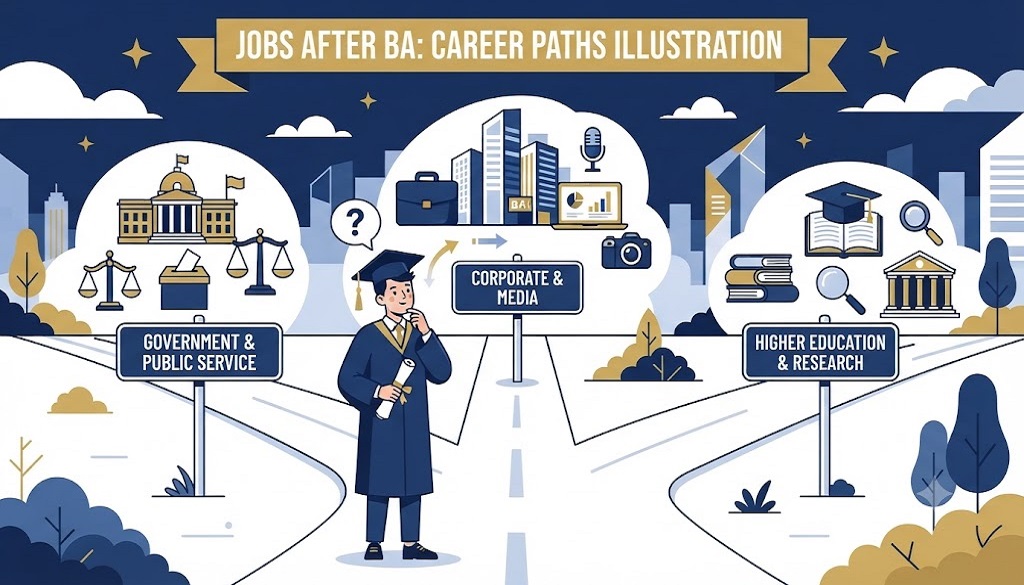
You’ve finished your BA, and it feels like everyone else already has a plan — engineering friends are eyeing tech jobs, commerce friends are prepping for banking exams, and you’re still figuring out what “jobs after BA” even looks like in practice.
Here’s the truth most guides skip: BA graduates have more genuine options than they’re usually told, but the right path depends heavily on your timeline, your subject, and how much further study you’re willing to commit to. This guide breaks it down honestly, with real 2026 salary numbers instead of vague promises.
Jobs After BA You Can Get Right Now (No Extra Course Needed)
If you need income soon, several roles are open to you immediately after graduation, without an additional degree.
Executive Assistant / Admin Roles
Companies across every industry need people who can manage schedules, coordinate communication, and keep operations running smoothly. Strong organizational and communication skills, which most BA programs build naturally, translate directly into this role.
Content Writer / Digital Marketing Executive
This is genuinely one of the fastest-growing entry points for BA graduates. Businesses need people who can write clearly and understand audiences, and a BA background in English, journalism, or even history often provides exactly that foundation.
HR Coordinator
Entry-level HR roles involve onboarding, employee communication, and basic policy coordination — work that rewards people skills over technical training.
Public Relations and Corporate Communication
If you enjoy writing and managing how organizations present themselves publicly, PR offers a natural extension of BA skills, particularly for graduates with a communications or political science background.
Quick Salary Table (Freshers in 2026)
| Role | Fresher Salary (Annual) | Key Skills Needed |
| Executive Assistant | ₹3-6 LPA | Organization, communication, MS Office |
| Content Writer/Digital Marketing | ₹2.5-4.5 LPA | Writing, basic SEO, social media |
| HR Coordinator | ₹2.5-5 LPA | Communication, people skills |
| PR/Corporate Communication | ₹3-6 LPA | Writing, media relations |
Government Jobs After BA (With Real Salary)
If stability matters more to you than speed, government roles remain one of the most searched paths for BA graduates, and for good reason.
UPSC Civil Services (IAS, IPS, IFS)
This is the most prestigious route available, letting BA graduates enter administrative services as IAS, IPS, or IFS officers. Officers typically start at ₹56,100 per month at the junior time scale, though the exam itself, conducted by the Union Public Service Commission, is genuinely one of India’s toughest.
SSC CGL
The SSC CGL exam opens doors to Group B and C central government posts, including Income Tax Inspector and Assistant Section Officer roles. Most positions start between ₹25,000 and ₹35,000 per month under the current pay structure.
Banking Sector Exams (IBPS PO/Clerk, SBI PO, RBI Grade B)
Banking remains one of the more accessible government-adjacent paths for BA graduates. Clerk-level roles typically start between ₹20,000 and ₹29,000 per month, while officer-level roles through IBPS PO or SBI PO start around ₹36,000 to ₹40,000 per month, plus allowances. If you’re specifically comparing these numbers, our detailed bank PO and clerk salary breakdown covers post-wise pay in more depth.
State PSC Exams
Every state runs its own public service commission exams, often with slightly lower competition than UPSC while still offering administrative roles like Deputy Collector or Block Development Officer.
CTET/UGC NET (Teaching and Academia Route)
If you’re drawn to teaching, clearing CTET (for school-level teaching) or UGC NET (for college-level teaching and research) opens a stable, respected career path, particularly if you pair it with an M.A. in your subject.
Government jobs after BA are worth the wait for many students, but only if you’re realistic about preparation time. Most successful candidates spend 12 to 24 months preparing seriously, so having a backup income plan during that period matters.
How Much Do BA Freshers Actually Earn in 2026?
Here’s the honest breakdown across sectors, since salary expectations vary more for BA graduates than for most other degrees.
| Path | Entry Salary | Notes |
| Corporate entry-level roles | ₹2-4 LPA | Admin, executive assistant, coordinator roles |
| Content/Digital Marketing | ₹2.5-4.5 LPA, rising to ₹7-10 LPA in 3-5 years | Fastest-growing private-sector option |
| IBPS/SBI Clerk | ₹20,000-29,000/month | Officer roles start higher, around ₹36,000-40,000 |
| SSC CGL | ₹25,000-35,000/month | Varies by specific post |
| UPSC (IAS/IPS/IFS) | ₹56,100/month (junior scale) | Highest prestige, toughest competition |
| NGO/Social Work | Starting around ₹18,000/month | Grows considerably at larger, international organizations |
It’s worth being upfront about one thing: multiple industry skill surveys have found that fewer than half of Indian graduates across all streams are considered fully job-ready by employers at graduation. That’s not a BA-specific problem, but it does mean the degree alone rarely guarantees a strong starting offer — the skills you add on top of it usually decide the outcome.
Jobs After BA by Field: Career Options to Explore
Beyond the general entry-level roles, several specific fields consistently absorb BA graduates.
Journalism and Mass Communication: Digital news platforms, content teams, and broadcast outlets all hire communication-strong graduates, with strong writers moving into ₹7-10 LPA content strategy roles within a few years.
Psychology and Counselling: BA Psychology graduates can move into HR, counselling support roles, or further study toward clinical practice, with entry salaries typically in the ₹2.5-3.5 LPA range before specialization.
Social Work and NGO Sector: Genuinely meaningful work, though starting pay is modest — expect growth mainly at larger, internationally funded organizations.
Business, Consulting, and Human Resources: General BA graduates increasingly move into junior consulting or HR analyst roles, especially when paired with an MBA later.
Creative Fields: Graphic design, content industries, and even translation and interpretation work offer niche but genuinely rewarding paths for graduates with the right skill combination.
Higher-Paying Paths — Is Further Study Worth It?
For many BA graduates, the real salary jump comes after an additional qualification, not from the BA alone.
MBA delivers the most dramatic salary increase, typically pushing earning potential to ₹6-25 LPA depending on the institute and specialization. It’s also one of the most common next steps for BA graduates aiming for corporate leadership roles.
Law (LLB after BA) suits graduates who enjoyed the analytical and argumentative side of their BA coursework, opening a path into litigation or corporate legal roles.
B.Ed and UGC NET make sense if teaching genuinely interests you, offering a stable, respected career with clear progression through school and university-level positions.
Master of Social Work (MSW) deepens career options in the NGO and social sector specifically, often unlocking program management roles with meaningfully higher pay than a BA alone would.
Best BA Subjects for Career Growth
Not all BA subjects lead to the same outcomes, and it’s worth knowing this before you specialize.
| Subject | Strongest Career Fit |
| Economics | Banking, business analytics, MBA preparation |
| Political Science | Civil services, public policy, journalism |
| Psychology | HR, counselling, further clinical study |
| English | Content writing, journalism, publishing |
Jobs After BA Without Maths: Career Options Explained”
Here’s some genuinely good news: no BA specialization requires mathematics at any stage, which makes this degree one of the most accessible paths for students who specifically want to avoid it. Every option covered in this guide — from government exams to content writing to an eventual MBA — is fully accessible without a maths background.
Common Mistakes BA Graduates Make
Even talented graduates trip up in a few predictable ways.
- Assuming BA only leads to teaching or government jobs — this outdated view causes many capable graduates to overlook genuinely strong private-sector options
- Not building any practical skill alongside the degree — a BA with zero added skills competes purely on the degree title, which limits early offers
- Waiting indefinitely for one government exam result — preparing for UPSC or SSC without any income plan for the preparation years creates unnecessary financial strain
- Ignoring private-sector and skill-based roles entirely — many students fixate on government jobs after BA without seriously exploring faster-paying alternatives
Applying for Jobs After BA: A Step-by-Step Guide
- Identify your strongest transferable skill — writing, organizing, or people management, based on what came naturally during your degree
- Add one practical skill through a short course — digital marketing, basic data tools, or content writing all have a fast learning curve and immediate hiring relevance
- Build a resume that highlights projects and internships, even informal ones; our resume format guide for freshers breaks down exactly what to include when you have limited formal experience
- Decide your timeline honestly — if you need income within three months, prioritize private-sector applications over long exam preparation
- Apply broadly rather than waiting for one ideal role, treating your first job as a stepping stone rather than a final destination
If you’re weighing this decision alongside other post-12th paths more broadly, this guide on career options after 12th is a useful starting point for comparing streams on the same basis. And if you’re specifically preparing for SSC CGL as your government route, our dedicated breakdown of the SSC CGL salary structure covers post-wise pay in detail.
Once you’ve built your resume and picked a direction, you can register your profile here to get matched with genuine entry-level openings rather than searching listings manually.
Frequently Asked Questions About Jobs After BA
Can I get a government job with just a BA degree?
Yes. A BA fully qualifies you for UPSC Civil Services, SSC CGL, most banking exams, State PSC exams, and CTET, since these require only a bachelor’s degree in any stream.
Is BA a useless degree in 2026?
No, though it does require deliberate skill-building. Graduates who pair their BA with a practical skill or professional exam preparation consistently outperform those who rely on the degree alone.
What is the average BA fresher salary in India?
Most private-sector freshers start between ₹2.5 LPA and ₹4.5 LPA, while government roles vary from roughly ₹20,000 per month at clerk level to over ₹56,000 per month for UPSC-cleared officer roles.
Which BA subject has the best career scope?
Economics and Political Science tend to offer the strongest structured paths, particularly toward banking, civil services, and public policy roles, though English and Psychology also lead to strong private-sector options.
Can BA graduates apply for government jobs without further study
Yes, most government exams accept any bachelor’s degree, meaning BA graduates can appear for these directly without needing a postgraduate qualification first.
What private jobs can BA graduates get immediately?
Executive assistant, content writing, HR coordination, and public relations roles are all realistically accessible right after graduation, without additional certification.
Is an MBA a good option after BA?
Generally yes, particularly if you’re aiming for corporate or leadership roles, since it typically offers the largest single jump in earning potential among all postgraduate options for BA holders.
Can BA students pursue government and private jobs at the same time?
Many do exactly this — working a private-sector job while preparing for a government exam in parallel — which is often a more financially stable approach than preparing full-time with no income.
Which skills gained during a BA degree are most valuable to employers?
Communication, research, and analytical thinking consistently rank as the most transferable BA skills, particularly for roles in writing, coordination, and client-facing work.
Conclusion
Jobs after BA in India are genuinely broader than most people assume — the degree itself is a strong foundation, not a limitation. Whether you go straight into a private-sector role, commit to a government exam, or invest in further study like an MBA or LLB, the direction matters less than the consistency you bring to building relevant skills afterward.
Pick one path, start building toward it deliberately, and treat your first job as a stepping stone. For more detailed salary and career comparisons across dozens of paths, explore Career Salary Hub.



1 comment