BBA vs CS vs Law After 12th Commerce: Which Should You Choose in 2026?
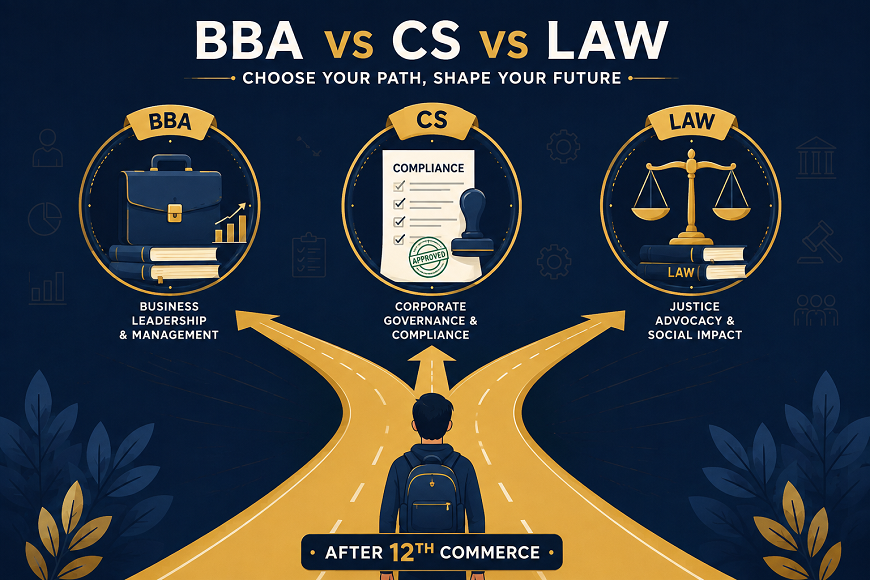
You’ve finished 12th commerce, and now three genuinely solid options are sitting in front of you: BBA vs CS vs Law. None of them need maths, all three lead to respectable careers, and that’s exactly what makes this decision so confusing.
This guide walks through a real BBA vs CS vs Law after 12th commerce comparison, using actual 2026 salary data, so you can choose based on facts rather than family opinions or peer pressure.
BBA vs CS vs Law After 12th Commerce: Quick Comparison at a Glance
Before diving into the details, here’s how these three paths stack up side by side.
| Factor | BBA | CS | Law (BA LLB/BBA LLB) |
| Duration | 3 years | 3-4 years (exam-paced) | 5 years (integrated) |
| Entry route | CUET, IPMAT, or merit | ICSI registration (CSEET) | CLAT, AILET, or LSAT |
| Fresher salary | ₹2.5-5 LPA | ₹3-6 LPA | ₹3-6 LPA (regular); ₹12-18 LPA (NLUs) |
| Difficulty | Moderate | High (self-discipline heavy) | High (long commitment) |
| Job security | Moderate | High | Varies widely by college |
BBA (Bachelor of Business Administration)
What You Actually Study
BBA covers general management, marketing, finance basics, human resources, and business operations. It’s broad by design, which is exactly why so many commerce students without maths gravitate toward it after 12th.
Real Fresher Salary in 2026
Most BBA graduates start between ₹2.5 LPA and ₹5 LPA, though this varies significantly by specialization. Business analytics and finance-focused BBA graduates at strong companies can push starting packages toward ₹8-10 LPA, while general management roles sit at the lower end.
Who Should Choose BBA
If you enjoy teamwork, presentations, and picture yourself managing people rather than reading legal statutes or compliance checklists, BBA fits naturally. It also works well if you’re planning an MBA later, since it builds the foundational business vocabulary you’ll need. Specializations like HR are common exits too — our HR executive salary guide shows what that specific path can look like a few years in.
Pros and Cons
BBA builds soft skills, networking ability, and business fundamentals quickly. However, a standalone BBA typically needs a follow-up MBA for genuinely top-tier executive growth — few companies hand out senior roles on a BBA alone.
Company Secretary (CS)
What You Actually Study
CS training covers company law, securities law, taxation, and corporate governance. Unlike BBA, this isn’t a college degree — it’s a professional qualification run through the Institute of Company Secretaries of India (ICSI), completed in stages: CSEET, then Executive, then Professional.
Real Fresher Salary in 2026
Most CS freshers earn between ₹3 LPA and ₹6 LPA, with candidates who clear their exams in fewer attempts and intern at reputed firms often starting closer to ₹6 LPA. At listed companies, where a CS is often legally mandated, packages can run higher still.
Why Demand for CS Is Rising
Tightening SEBI regulations and Companies Act compliance requirements mean more companies now need a dedicated CS on their books, not just as an administrative role but as genuine corporate governance support.
Who Should Choose CS
If you’re detail-oriented, comfortable with self-paced study, and don’t mind reading dense legal and regulatory text for a living, CS suits you well. It’s also a strong option if you want to study alongside a regular degree like B.Com, since ICSI registration doesn’t require full-time attendance.
Pros and Cons
CS is a highly respected qualification with genuinely no maths requirement at any stage. That said, it demands serious self-discipline, since there’s no classroom structure forcing you to study — the multi-stage board exams reward consistency over cramming.
Law (BA LLB / BBA LLB Integrated)
What You Actually Study
The 5-year integrated law programs combine criminal, civil, constitutional, and corporate law with business modules if you choose the BBA LLB track specifically. It’s the longest commitment of the three, but also the one with the widest earning range.
Real Fresher Salary in 2026: The Brutal Truth
Here’s what most guides don’t say clearly enough: your college matters more in law than in BBA or CS. Graduates from National Law Universities (NLUs) or those placed at Tier-1 firms typically start at ₹12-18 LPA. Graduates from regular, non-NLU colleges usually start between ₹3 LPA and ₹6 LPA — a genuinely massive gap for the same degree title. Admission to the profession itself, including the right to practice, is regulated by the Bar Council of India, which requires clearing the All India Bar Examination after your degree.
This is why clearing CLAT and getting into a strong law school matters far more for your law career than exam performance matters for BBA or CS outcomes.
Who Should Choose Law
If you’re a strong communicator, enjoy debating and building logical arguments, and don’t mind a longer, harder path before things pay off, law is worth serious consideration. It also suits students who want the option of corporate legal work, litigation, or public policy roles down the line.
Pros and Cons
Law offers the highest ceiling among these three options, especially in corporate law at top firms. The tradeoff is a full 5-year commitment, plus genuinely slower financial returns in the early litigation years if you don’t land a strong firm placement immediately.
Salary Growth Comparison: BBA vs CS vs Law Over 10 Years
Looking at a single entry-level number rarely tells the full story. Here’s how earning potential typically evolves over a decade.
| Path | Entry-Level | 5 Years | 10 Years |
| BBA | ₹2.5-5 LPA | ₹6-10 LPA | ₹15-25 LPA (with MBA/specialization) |
| CS | ₹3-6 LPA | ₹8-15 LPA | ₹20-40 LPA (listed company roles) |
| Law (regular college) | ₹3-6 LPA | ₹8-15 LPA | ₹20-35 LPA |
| Law (NLU/Tier-1 firm) | ₹12-18 LPA | ₹25-40 LPA | ₹50 LPA+ |
BBA vs CS vs Law: Which One Should You Choose?
A simple way to cut through the confusion is to ask yourself three questions in order.
- Do you enjoy arguing, debating, or building logical cases? If yes, lean toward Law.
- Do you prefer structured, rule-based work with clear compliance frameworks? If yes, CS is likely your fit.
- Do you want broad management exposure and enjoy working with teams? If yes, BBA makes the most sense.
There’s no universally “best” answer in the BBA or CS or law which is better debate — the right choice depends entirely on which of these questions you answered yes to first.
Common Mistakes Students Make When Choosing
- Picking Law without researching college-tier reality — assuming any law degree guarantees a ₹12+ LPA package, when only NLU and Tier-1 firm placements typically reach that range
- Choosing CS without accounting for exam attempts — not realizing that clearing exams in fewer attempts genuinely affects your starting salary and hiring prospects
- Picking BBA “because everyone does it” — enrolling without any specialization plan, then struggling to differentiate yourself from thousands of similar graduates
- Ignoring long-term goals for short-term prestige — choosing a path purely because it sounds impressive at family gatherings, rather than because it fits genuine interest
Can You Combine Two of These Paths?
Yes, and it’s more common than most students realize.
CS + LLB: Combining a CS qualification with a law degree significantly boosts your earning potential in compliance-heavy legal roles, since you bring both corporate governance expertise and formal legal training to the table.
BBA + LLB (Integrated BBA LLB): This 5-year integrated program gives you a dual perspective — management fundamentals alongside full legal training — and opens doors specifically in corporate law and business advisory work.
If you’re weighing this decision alongside other post-12th options more broadly, our guide on career options after 12th covers how commerce, science, and arts streams compare on the same salary-first basis.
How to Actually Decide: A Practical Checklist
- List your genuine interests — not what sounds prestigious, but what you’d tolerate studying for years
- Research the realistic salary range for each path, not just the highest number you’ve heard about
- Check entrance exam difficulty — CLAT is significantly more competitive than most BBA entrance tests
- Talk to someone actually working in each field, rather than relying purely on internet research
- Consider your risk tolerance — Law’s high variance suits risk-tolerant students; CS’s steadier progression suits those who prefer predictability
Once you’ve settled on a direction, building a strong resume becomes the next priority. Our resume format guide for freshers walks through exactly what recruiters expect from candidates with limited or no work experience.
Skills That Matter Most for Each Path
Beyond the degree or qualification itself, certain skills consistently separate high performers from average ones in each field.
For BBA: Communication and presentation skills matter enormously, since much of the coursework and early job roles involve pitching ideas, leading discussions, and coordinating across teams. Basic proficiency in Excel and PowerPoint is expected from day one in most corporate roles.
For CS: Attention to detail is non-negotiable. A single missed compliance filing or misread clause in a company law provision can create real problems for an employer, so CS professionals who build a reputation for precision tend to get faster promotions.
For Law: Strong written and verbal argumentation skills matter more than raw memorization. Moot court experience during your degree, even if you don’t pursue litigation afterward, meaningfully strengthens your resume for corporate legal roles too.
Regardless of which path you choose, a working understanding of basic office tools and clear professional communication will serve you well. If you’re preparing for interviews in any of these fields, practicing how to discuss your expected compensation confidently is equally important — our guide on answering salary expectation questions breaks this down for Indian interview settings specifically.
A Quick Reality Check Before You Decide
It’s worth repeating: the BBA vs CS vs Law after 12th commerce choice isn’t just about which path pays the most on paper. A high-ceiling option like Law only pays off at that ceiling if you clear a competitive entrance exam and secure a strong college seat — something worth honestly assessing before committing five years. Similarly, CS rewards patience and consistency far more than raw intelligence, and BBA rewards students who actively build a specialization rather than coasting through a generic degree.
If you’re still unsure which bucket you fall into, it often helps to shadow or speak with someone one or two years ahead of you in each field. Their day-to-day reality, not the glossy brochure version, usually settles the decision faster than any comparison table can. Once you’ve picked a direction and started building relevant experience, you can register your profile here to get matched with genuine entry-level openings as they come in.
Frequently Asked Questions: BBA vs CS vs Law
Is CS better than BBA?
It depends on your interests. CS offers a more structured, exam-based path into corporate governance, while BBA offers broader management exposure with more flexibility but typically requires an MBA later for senior roles.
Can I take Law after 12th commerce without maths?
Yes, absolutely. Law entrance exams like CLAT test reasoning, English, and general knowledge, not advanced mathematics, making it fully accessible to commerce students without maths.
Which is best, BBA LLB or BCom LLB?
BBA LLB leans toward management and business strategy alongside legal training, while BCom LLB leans toward accounting and finance alongside law. Choose based on whether you prefer management or numbers-heavy commerce subjects.
Which pays more, CS or corporate law?
At the entry level, they’re broadly comparable (₹3-6 LPA for regular graduates in both fields). However, corporate lawyers at Tier-1 firms or NLU graduates can significantly outpace CS salaries within the first few years.
Is BBA a waste of time compared to CS or Law?
No, but it does require follow-through. BBA alone rarely leads to senior roles, so pairing it with an MBA or a strong specialization is important for it to pay off long-term.
What percentage is required for LLB after 12th?
Most law colleges require a minimum of 45-50% in 12th grade, though top National Law Universities effectively require a very strong CLAT rank rather than focusing on board exam percentage alone.
Does CS require a college degree first?
No. You can register for the CSEET directly after 12th grade through ICSI, without needing a bachelor’s degree, which makes it one of the fastest professional qualifications to begin.
Is the BBA vs CS vs Law after 12th commerce decision reversible if I choose wrong?
To some extent, yes. BBA graduates can pursue CS or an MBA afterward, and CS professionals occasionally add an LLB later. Law is the hardest to reverse simply due to its 5-year length, so it deserves the most upfront research.
Which of these three has the best job security?
CS tends to offer the most predictable job security, since regulatory requirements create consistent demand. Law and BBA outcomes vary more heavily based on college reputation and specialization.
Conclusion
The BBA vs CS vs Law after 12th commerce decision doesn’t have a universal right answer, and that’s genuinely fine. BBA rewards flexibility and people skills, CS rewards discipline and structured compliance work, and Law rewards strong communicators willing to play a longer game with a wider payoff range.
Take the time to honestly match your interests and risk tolerance against the realistic salary data in this guide, rather than choosing based on prestige alone. For more detailed career and salary comparisons across dozens of paths, explore Career Salary Hub.




Post Comment